
Most farmers focus on what they can see: the crop, the weather, and the yield. But some of the most important activity on any farm happens underground, where millions of tiny organisms are constantly working. Understanding the soil food web helps you make better decisions about how you manage your land.
And once you understand it, you start to see your soil completely differently.
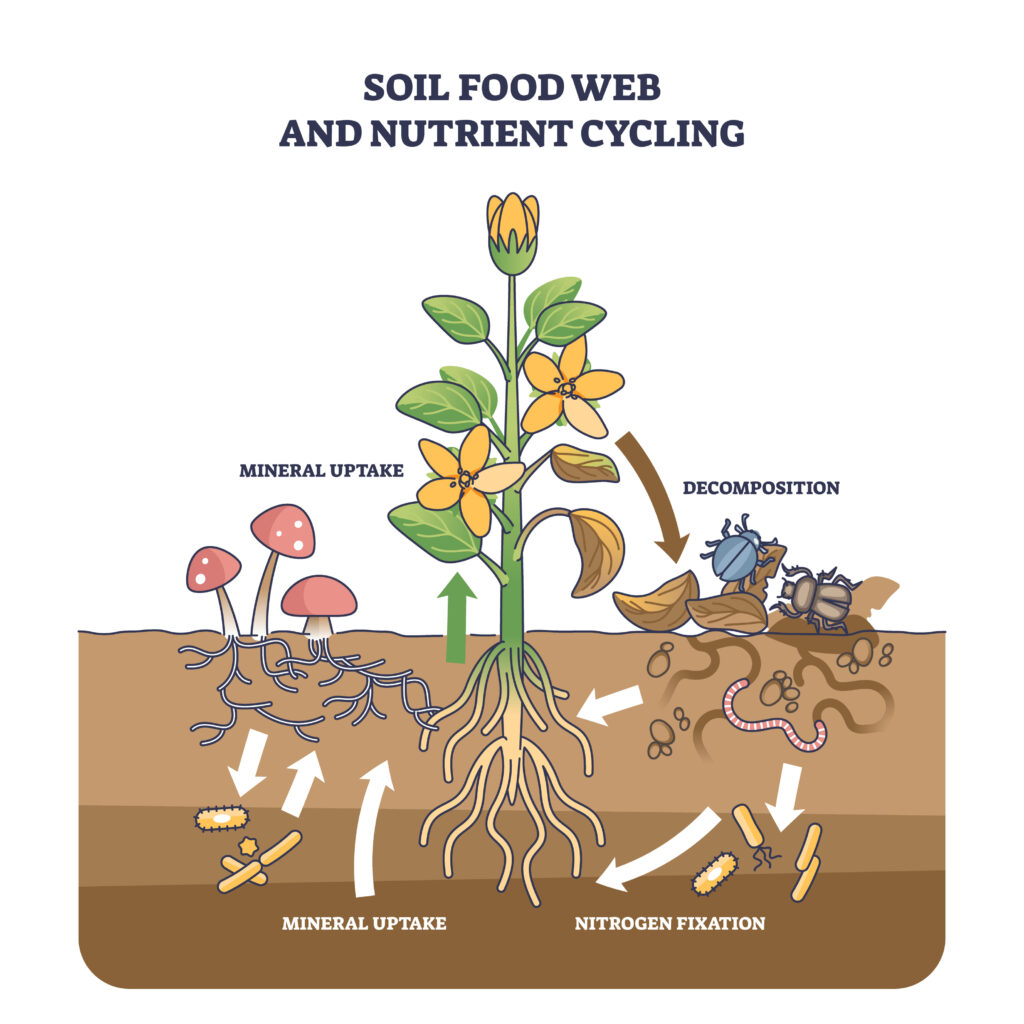
The soil food web is the network of living things that exist in healthy soil. Bacteria, fungi, protozoa, nematodes, earthworms, and many other organisms all interact with each other and with plant roots in a constant cycle of feeding, dying, and decomposing.
Think of it like a food chain, but underground. Plants feed microbes. Microbes feed larger organisms. Those organisms die and release nutrients back into the soil. The cycle keeps going, and plants benefit from every stage of it.
Healthy soil is not just dirt with some nutrients in it. It is a living system. When the microbial biomass in your soil is strong, meaning the bacteria and fungi populations are active and balanced, several things happen naturally:
Bacteria and fungi are the foundation of the soil food web. They break down organic matter, release nutrients, and build the structure that holds soil together.
Bacteria tend to dominate in soils that get tilled frequently or treated with synthetic fertilisers. They cycle nutrients quickly but do not build long-term soil structure as effectively.
Fungi are slower but more powerful for long-term soil health. Fungal networks connect plant roots, transport nutrients over long distances, and help build the stable carbon structures that improve water retention. The fungal-to-bacterial ratio in your soil tells you a lot about where your soil health currently stands.
For agronomists working with multiple farms or fields, understanding the soil food web shifts the conversation from “what fertiliser do we apply” to “what does the biology in this soil actually need.”
That is a more useful question. It leads to decisions that improve long-term productivity rather than just patching short-term deficiencies.
The challenge has always been measurement. Soil microbial testing used to require lab equipment, long waiting times, and high cost. That made frequent testing impractical for most farms.
The soil food web is not a complicated concept once you break it down. Living soil feeds plants. Healthy microbes reduce the need for external inputs. And tracking soil biology over time gives farmers and agronomists the information they need to make genuinely better decisions.
The soil is already doing the work. Understanding it just helps you work with it instead of against it.