
 American BioChar Company is a Michigan-based company run by longtime green industry couple, Mark & Laurie Mann. For more than two decades, they have been researching and developing programs and products to improve soils, root conditions, and plant growth in urban, rural, and agricultural landscapes.
Over the last 3 years, they have conducted trials on blueberry farms in SW Michigan, using the microBIOMETER® and other soil-metric tests. The trials compared soils of blueberry bushes treated with their VITAL Blend soil amendment to those with untreated soil. Data was collected in the spring, summer and fall each year to demonstrate the natural ebb & flow of microbe communities in soils. Not only does the data show the steady increase of soil microbial biomass, but overall the trial sites have improved soil structure and more nutrient dense crops.
“The biggest impact we have in using the microBIOMETER® is demonstrating the successful transformation within the soil, following applications of our different biochar blended soil amendments. It provides confidence in our product and helps move the client conversation toward the biological benefits of our product. When a client is able to see and track the fungal to bacterial ratio for their soil overtime, it is very empowering.”
American BioChar is also undergoing several other trials throughout the mid-west with corn, cannabis, soybeans, and tree rhizospheres, using both their VITAL Blend and their new GRATEFUL Blend living soil. As both blends provide active and fixed carbon to soil, these trials were aimed to enhance and increase soil biology and restore nutrient density. Pre- and post- application photos can show how these products improved overall crop production.
Recently, Laurie Mann and microBIOMETER® president Laura Decker participated in Heart & Soil Magazine‘s Soil Summit discussing “How to Increase the Speed of Microbe Growth”. Click here to watch!

 Gurpreet Kaur, a PhD student with the Nutrient Management Spear Program (NMSP) at Cornell University, has been working with microBIOMETER® soil testing kits to evaluate the impact of dairy manure application and field history on soil health and yield in corn fields in New York.
This project is part of a larger “New York Value of Manure Study” funded by New York Farm Viability Institute (NYFVI) and Northern New York Agricultural Development Program (NNYADP).
With support from the Toward Sustainability Foundation and microBIOMETER®, soil health assessments were done for three trials in 2023. The team selected three fields, differing in manure history from no manure history to yearly applications, and took soil samples at three different timesteps during the growing season. Among other measurements, Kaur is valuating microbial biomass and fungal to bacterial ratios using the microBIOMETER® test kit. Preliminary results obtained to date show the impact of field manure history on microbial biomass. As part of the project, several Cornell University undergraduate students are learning how to conduct the microBIOMETER® test as well.

There are many soil tests on the market so it can be difficult for farmers to ascertain whether or not they’re choosing the right one. The truth is, there are pros and cons to every soil test. Therefore it boils down to finding which ones align best with your farming goals and which are easily and readily available to you without needing to stretch your resources too much.
Since microBIOMETER® is a relatively new soil test on the market, a lot of questions are raised on how this test is different from other commonly used soil indicators such as the Haney Soil Test and PLFA test. While all three are soil biological health tests, their methodologies are very different and the tests measure different parameters.
The microBIOMETER® is an on-site soil test that measures the microbial biomass and fungal to bacterial ratio of living and dormant bacteria and fungi. The test process works by measuring the color intensity of the microbial solution created and comparing the color to the test card comparator. This patented, colorimetric analysis process is generated through our microBIOMETER® Reader App and produces results within 25 minutes of starting the testing process. Test prices range from $13.50/sample to $6.75/sample. The low cost, rapid result detection, and on-site testing of living soil are what makes this test stand out against others. The microBIOMETER® has a slightly limited scope, however, as it’s only able to measure the overall biomass of fungi and bacteria. It does not differentiate between microbial species nor does it measure any other parameters.
The Haney Soil Test is a lab test that focuses on assessing a variety of soil parameters such as pH, microbial biomass, water extractable organic carbon and nitrogen, soil respiration, and inorganic plant available nutrients such as NPK. This test uses multiple methods in order to obtain results, including the Solvita CO2 Burst test to indicate soil microbial respiration and biomass, and the use of unique soil extracts to determine organic and inorganic nutrient availability. While this test offers a large array of soil parameters, there is controversy in the science community about using the Solvita CO2 Burst test methodology as a way of accurately predicting microbial biomass. This is because the soil is dried then rewetted to trigger a release of CO2 to measure microbial activity. Drying soil decreases microbial biomass, and while rewetting it will increase biomass again, it doesn’t necessarily repopulate back to the original microbial composition. The Haney Soil test is offered at several labs throughout the country and recommendations are included with results. Generally, this lab test costs about $50/sample and takes about 3-4 weeks to receive results.
The PLFA Soil Test is a lab-based technique that analyzes phospholipid fatty acids (PLFA), which are found in the cell membranes of living organisms, to determine an estimation of living microbial biomass, fungal to bacterial ratio, and to identify the general presence or absence of microbial functional groups in bacteria, fungi, and protozoa. For this test, labs first dry the soil overnight then use multiple solvents to extract fatty acids from the sample. Then, mass spectrometry is used to identify the sample’s microbial composition based on specific PLFA biomarkers. This testing process takes a few days to complete and generally costs about $60/sample depending on the lab. It is one of the most utilized testing methods since it gained popularity in the late 80’s. Since then, it was discovered that some of the PLFA biomarkers used for identification aren’t limited to one microbial group, therefore making it difficult to determine the accuracy of some results.
The value of each of these tests is to determine a baseline assessment of your soil health. The information obtained from any of these tests will help you gain a better and more rounded understanding of what’s happening in your soil.
 Kenley Mitchell, a 5th grader at Sargent Elementary School, utilized microBIOMETER® in her science fair project titled “Getting Dirty: Does Soil Affect a Dog’s Microbiome?” Kenley won first prize in her category and received the overall best project award for the San Luis Valley Regional in Alamosa, CO!
Project Abstract:
For my project, I tested a dog’s microbiome and compared it to the health of the dog’s soil. I also looked at the time the dog spends in the soil. I ran two samples. The first sample was a stool sample. The second sample was a soil sample. Both were taken at the same time. I tested dogs that are in the city vs. country dogs. I found out that farm dogs have a healthier microbiome, but city dogs have healthier soil. The farm dogs’ average microbial biomass in the soil is 221.0 ug C/g. The city dogs’ average microbial biomass in the soil is 273.4 ug C/g. Farm dogs average for F% is 20%. City dogs average for F% is 32%. Farm dogs average for B% is 80%. City dogs average for B% is 68%. The farm dogs were outside in the soil for longer periods of time. The farm dogs might be healthier due to spending more time in the soil.
 Francis Lawton an 8th grader at St. Timothy School in Los Angeles, CA utilized microBIOMETER® in his science fair project titled “The Effect of Greywater on Plant Growth, Soil Microbial Biomass Carbon, and Soil Fungi to Bacteria Ratio. Francis took first prize at the fair and moved on to the Los Angeles County Science & Engineering Fair where he placed 3rd in his category of Ecology. He also received a special award from USAID (U.S. Agency for International Development). Francis then took part in the California State Science & Engineering Fair in the category of Earth & Environment (Air/Water) and placed 2nd!
Have a science fair project coming up and would like to incorporate microBIOMETER®? Please contact us!
Project Abstract:
This project was designed to find out if greywater and treated greywater can safely hydrate plants, and promote plant growth, just as well as tap water. I live in drought-prone California and it’s important to find different ways of conserving water. My experiment tested the watering of grass pots with three different types of water (independent variable): Tap water, Greywater, and Greywater treated with Activated Charcoal. Over the course of 8 weeks, I measured plant growth, soil Microbial Biomass Carbon (MBC) levels and soil Fungi to Bacteria (F:B) ratio (dependent variables). Many controlled variables ensured a valid experiment. I hypothesized that each of the water types would result in the same growth rate, soil MBC and soil F:B ratio. My hypothesis, however, was incorrect. Greywater resulted in stunted growth and spiked the F:B soil ratio so high that the pot sprouted 13 fungi heads. Tap water and Treated Greywater, however, were equally good in terms of healthy plant growth and both pots had the two best average F:B ratios closest to 1:1 (which is the best ratio for grasses). Neither of these pots produced fungi. Soil carbon levels (MBC) fluctuated for all three plants, however each plant maintained an “Excellent” level. This indicated that each water type was fine for watering grass if you don’t mind stunted grass growth and some fungi in your lawn. My experiment also proved that Activated Charcoal effectively “adsorbs” chemicals in greywater that alter a soil’s F:B ratio.
 The microBIOMETER® was developed with the need in mind to deliver a device that could be manufactured very reasonably so that it could service the whole world. For over 50 years scientists have known that microbes are the best indicator of soil health. One of the common methods used for determining soil microbial biomass is the Chloroform Fumigation Extraction (CFE) test. However, being a costly lab-based test makes it an unattainable option for many. Another method that’s often used to assess soil microbial communities is microscopy. While microscopy is one of the best ways to assess soil microbes, microscopes can be expensive, are often too large and heavy to bring into the field, and are not necessarily easy to use or easily accessible for growers around the world. In 2014, Dr. Fitzpatrick began developing the microBIOMETER® to address these shortcomings.
The microBIOMETER® was designed to detect bacteria and fungi by their pigmentation on a specially designed membrane. An extraction powder was developed that contains different salts, which, combined with precise whisking, separates the microbes from the soil particles. The addition of this extraction powder also helps to precipitate the soil so that the microbes stay suspended as the soil precipitates to the bottom of the test tube.
Once the microbes are separated from the soil, they can be detected by spectrophotometry. However, like a microscope, a spectrophotometer is both expensive and too large to use in the field. The solution, in keeping with the goal of manufacturing a very cost-effective device, was to make it a lateral flow membrane. Almost all medical devices do a vertical flow, but a vertical flow has many technical problems. In a vertical flow, different types of membranes are put together and then a clamshell type device is used to press it down, but this pressure then has to be regulated. And Dr. Fitzpatrick, having worked with many clamshell devices, knew this method caused a great deal of seepage around the outside. A lateral flow, on the other hand, is more rapid than a vertical flow which allows the sample to be put on more rapidly than you can when you’re using a vertical flow device. The flatness of the device is important as well. Most other devices that are vertical have a rim around the area where the membrane is which is called a sample well. If you look down the well you cannot see the bottom because the well walls are casting a shadow. But microBIOMETER® is flat, therefore, a shadow does not pose a problem.
To perform the test, three drops are applied to the membrane in the test card. The microBIOMETER® membrane was carefully chosen so that it would not bind any of the common pigments you might find floating in soil. It only collects microbes on the surface of this membrane. The membrane also whisks away the liquid and traps the microbes on the surface. The color that it gives to the membrane can be compared to a grayscale, which tells you that the intensity of the color, not the color itself. The intensity of the color correlates with the quantity of microbes you have. Just like with the colorimeter or spectrophotometer, the intensity of the color is linearly related to the concentration of microbes. Dr. Fitzpatrick came up with this grayscale idea while thinking about a quilting secret. Quilters want to make sure they not only have different colors but have different intensities of color as well. Therefore, we’re not just measuring color but also measuring the intensity of the color.

 The next step in the development was to figure out how to read the test cards. In the early version of the microBIOMETER®, a red filter with a grayscale was used, turning it monochromatic. A piece of red cellophane was put over the grayscale in the sample window and the results were determined by how dark the center was. This earlier version of microBIOMETER® is still being used by customers who are non-tech users.
At this point, the test could be read visually but it lacked precision, and data storage and tracking capability. For this, it was decided a phone app was needed. One of the barriers to lab testing in developing countries is cost, but another is infrastructure. However, cell phones are ubiquitous. If an app to read the test cards and store the data was created, soil stewards all over the world would have the ability to track soil health over time and assess their management practices while making changes in real time.
The challenge to the cell phone is that cell phones have a camera and manufacturers utilize different software. Therefore, the image viewed isn’t raw and overcoming the differences between various phones becomes necessary. The microBIOMETER® does that with the monochromatic grayscale backing. This in essence “tricks” all phones to be in the same range in their software and white balance. The issue of different color temperatures was also encountered. When you’re out in the sun on a cloudy day or you’re in the shade on a sunny day that light is extremely blue. When you’re sitting in your living room and you have a 60-watt light bulb, that light is yellow/red. And if you’re at the office with a fluorescent light that light turns out to be white -where red, green, and blue are all equal. Therefore, accounting for differences not only in cell phones but in ambient lighting conditions became important as well.
This stage of test development consisted of vigorous testing and a good amount of trial and error. The process involved running around with a test card from light source to light source with five or six different phones making sure the readings were consistent. By utilizing the camera’s flash in conjunction with a monochromatic backing, the images between phones became uniform. Once the patented algorithm that compensated for differences in light color and intensity and phone software was finalized, in 2018, the microBIOMETER® was released to market.
 A few years later, in 2020, Dr. Fitzpatrick and Dr. Trexler tossed around the idea of adding another soil test to the microBIOMETER® platform; the fungal to bacterial ratio. During one of these discussions, Dr. Trexler inquired if there was a way to use size to differentiate bacteria and fungi. As a microbiologist, Dr. Fitzpatrick knew that bacteria are much smaller than fungi and therefore could be differentiated based on size. Dr. Trexler then wrote software that could detect and pick out the bacteria and fungi. It was discovered that when looking at a fungal to bacterial ratio on the microscope, a slight change in the color was evident; fungi are a very, very slightly different color than bacteria. There was a correlation between the color of the sample and the fungal to bacterial ratio that was detected microscopically, which turned out to be a groundbreaking discovery. After trying various methods for determining the fungal to bacterial ratio by color, it turned out cell phone cameras had the ability to pick up the difference. This discovery led to the fungal to bacterial ratio data being added to the microBIOMETER® app.
The following year, another exciting feature was added to the platform; Project Management (PM). A big advantage of reading results with a cell phone is that the data can be stored on the cloud. When the app was first written, there were a few different data fields for each sample. There was crop quality, crop type, soil class, and a couple other generic fields. It was soon realized that people using the test were likely more knowledgeable about what data and metrics assisted with farming. So, the app was updated to allow users to create their own fields based on their needs. This development was the release of Project Management (PM). Now, users can have as many fields of data as they want and it’s completely adjustable. Another benefit of PM is it lets users create a project and anyone on the team can upload their test results to the project. Before PM, everyone’s samples were on their own phone and in their cloud account. Now all the samples, regardless of who performed the test, are in one place and can be easily downloaded for analysis. Users can create as many projects as they want to keep trials separate from each other, but with all the data aggregated. There is one microBIOMETER® customer who currently has 20 different projects that match up with each of the properties they manage.
microBIOMETER® allows users to quickly determine if they are achieving the improvements they are looking for; track soil microbial activity over time and see how it varies with practice in order to assess what is working and what is not. With an innovative, yet inexpensive soil test like microBIOMETER®, $7 to $14 compared to much more expensive tests, growers can sample more per acre, allowing them to acquire a better understanding of their crops. With the ease of multiple sampling combined with data storage, users can view year over year and season over season results to see if their microbiology is increasing and if their soil health is increasing as a result.
 It is important that the microbiology increases because there’s an incredibly high correlation between soil biology and soil health. We know that as microbial activity increases, so does the water holding capacity of the soil. It also makes crops more resistant to excess water – which can lead to erosion. Soil microbes build soil structure, which mitigates drought as well as flooding risk because it improves the texture of the soil. Microbes make a glue-like substance which enables them to stick to the soil. This stickiness remains after the microbes die and causes the soil to become clumpy. These clumps allow the soil to hold more oxygen, as it provides more aeration. Growers can improve the amount of carbon in their soil since the stored carbon in your soil is the bodies of dead microbes. When a microBIOMETER® soil test is performed, you’re looking at a snapshot of the microbes. They’re constantly turning over and they are food for other predators in the ecosystem. But that turnover demonstrates that you have a large number of microbes and that the entire ecosystem is being fed.
When you feed the soil ecosystem – from microbes to earthworms to mammals – that’s when you achieve the healthiest soil. Many creative and innovative practices are being developed that understand that healthy soil is part of a healthy system. The start is a healthy microbial ecosystem and microBIOMETER® gives you a glimpse into that very, very quickly. There’s nothing else like it.
This article is based on the video The History and Science behind microBIOMETER®

Both microbial biomass and respiration are parameters used to assess soil health. Soil respiration is the measure of the carbon dioxide produced by the microbes in a given weight of soil while microbial biomass is the measure of the mass of microbes- both active and dormant.
Microbial biomass (MB) is an excellent predictor of soil health because the size of the microbial population correlates with the available nutrients in the soil. Interestingly, MB is low in soil treated with high levels of mineral fertilizers. Research has shown that the stimulus for the plant to grow a microbial population is its need for nitrogen and phosphorus. If these nutrients are artificially supplied, the plant is not being stimulated to feed the microbes that usually provide these nutrients to the plant. This can alter plant-microbe interactions and cause an increased need for pesticides in order to protect the plant, as microbes play a fundamental role in the function of the plant’s immune system.
Microbial respiration measures the amount of carbon dioxide (CO2) produced by the microbes in a given weight of soil. The soil is dried and then rewetted and put in an airtight jar that allows measurement of the amount of CO2 produced over 24 hours. The CO2 is produced by the activity of the microbes in the rewetted soil. Between 20% and 70% of the microbes die during drying, but their dead bodies often provide nutrition for the survivors to use and regrow the population to its original level. Respiration reflects the regrowing work that is being done. The respiration level is often mistakenly believed to predict microbial biomass, though it doesn’t.
People often assume a high respiration rate is good because it means there is a lot of microbial activity occurring. However, it doesn’t necessarily mean the soil is healthy. Microbes in a low pH or toxic soil have to work harder, and therefore their respiration rate is higher, just as your respiration rate in the gym is higher than when you are watching TV. High respiration rates can indicate an unstable microbial population, which, for example, can be seen after excessive tillage occurs. Tillage aerates the soil, so right after there is often a boost of microbial respiration. That increased activity however does not always last, as the other damage done by tillage – disruption of microbial life and destruction of existing plants- can lead to a decreased soil microbial population over time.
The use of soil primers stimulates an increase in soil organic matter (SOM) decomposition, which temporarily increases microbial respiration. Excessive decomposition of SOM can cause a loss of stored soil carbon and other mineral nutrients, allowing for the increased production of CO2. Basically, when you stimulate the soil using a fertilizer or biostimulant, it’s an all-you-can-eat buffet for the microbes. It wakes them up and they start growing and reproducing. But whether they can continue to grow depends on the continual supply of existing nutrients and plant life in the soil. It’s very important that there be sufficient food for the microbes after stimulation. For most soils, this requires that the fertilizer have the correct C:N ratio for the soil and crop. A fertilizer with too high a C:N ratio will cause the microbes to harvest some of the stored carbon, nitrogen and other nutrients in the soil, boosting respiration. This means the stored carbon is being depleted and released into the atmosphere as CO2, the microbes won’t be able to nourish the plant and build soil structure as needed. Adoption of less invasive management practices, such as select-till and reduced chemical fertilizers can reduce CO2 emissions from agricultural soils by retaining soil organic matter.
Priming can be a good way to understand the difference between and uses of respiration data and microbial biomass data. Testing for both initial respiration and long term microbial biomass population can tell you if the priming worked and if the increase in microbial activity led to increased soil microbial biomass and therefore increased soil health and fertility.

Seasonal dynamics are a major driver of soil microbial communities. Much like you and I, microbes are more active during some seasons, and more dormant during others. This can be attributed to the different responses microbes have to nutrient inputs, climatic conditions, and other soil properties. As there are a lot of factors that affect microbial activity, it can be difficult for farmers or researchers to make definitive statements regarding the relationship between their soil microbial communities and seasonal changes. Specifically, temperature, moisture content, and the existence of plant life are considered the most important factors affecting microbial growth and activity within a season.
The presence of plants on the soil has a large impact on microbial life. As plants form, they begin to cultivate microbes surrounding their roots by producing nutrients for the microbes to essentially feed on. As the microbial community grows, they undergo a series of processes allowing them to obtain nitrogen and mineral nutrients from the soil and then provide the nutrients back to the plant to stimulate growth. This is part of the symbiotic relationship between plants and microbes– they support each other through the mining of nutrients from the soil and sun.
Just like plant presence, temperature greatly influences soil microbial properties. During cold seasons, temperature is considered a major limiting factor of microbial activity, whereas water availability could be a limiting factor during the summer season. Soil temperature can affect organic matter decomposition and mineralization rates, thereby impacting microbial biomass and activity levels. Bare soil, or soil without any plants growing, will have lower microbial activity occurring, regardless of season. This is why researchers and land stewards have emphasized the planting of cover crops between growing seasons in regenerative agriculture– as cover crops can alter soil properties and increase the biomass and diversity of microbial communities. In the warmer or hotter seasons, the addition of cover crops can also help to mitigate how much heat the soil is absorbing.
Studies show that microbial activity in agricultural soils increases in the fall when compared to other growing seasons–likely due to an increased level of nutrients and soil organic matter from crop and plant residue post harvest. Throughout the wintertime, or non growing season, microbial activity and composition is thought to be stagnant, but stable. An increase in microbial activity is said to occur after the thawing of frozen soils and can be linked to the freeze-thaw cycle (FTC) that colder climates experience. As snow freezes over soil, it inhibits air diffusion from occurring, creating anaerobic conditions for the microbial communities and therefore altering the soil community structure. In turn, this causes an increase in denitrification, respiration, and production of greenhouse gases, which are being trapped under the frozen layer. Once temperatures begin to rise, the soil begins to thaw, allowing oxygen into the soil. This provides labile carbon and other nutrients to the soil, which increases microbial activity and biomass. However, once thawing occurs, those greenhouse gases that were once trapped, are released into the air. This exact dynamic between microbial activity and the FTC is still being debated due to different soil properties greatly affecting freeze/thaw rates and as researchers use different methodologies, making it difficult to compare results between studies.
But despite the controversy surrounding the exact relationship between microbes and seasonal temperature changes, researchers do agree that microbial biomass and activity are related to seasonal temperature fluctuations. They’ve found that generally, microbial biomass decreases once the temperature increases past a certain point. As temperature increases, there is also an increase in CO2 being released from the soil, which we refer to as respiration. So when more respiration occurs, more carbon is being put into the air. This respiration process is sensitive to temperature change, which is why it’s imperative to have a better understanding of the seasonal dynamics of microbial communities.
As soil microbial life varies naturally by season, it might be hard to differentiate the natural seasonal changes from the changes related to your regenerative growing practices. Understanding the short term seasonal dynamics of microbial communities in various soil conditions is key in furthering our understanding of soil biology. Documenting and analyzing periodic readings with microBIOMETER® can assist you in differentiating between natural and seasonal changes in your soil.
References:
Bates, Todd B. (2018, Oct 10). How Plants Harness Microbes to Get Nutrients. Rutgers.edu.
https://www.rutgers.edu/news/how-plants-harness-microbes-get-nutrients
Bizzell, E. (2018, April 16). Plants and the bacteria at the root of it all. ASM.org.
https://asm.org/Articles/2018/April/plants-and-the-bacteria-at-the-root-of-it-all
Gao H, Tian G, Khashi u Rahman M and Wu F (2022) Cover Crop Species Composition Alters the
Soil Bacterial Community in a Continuous Pepper Cropping System. Frontier Microbiology. 12:789034.
Jensen G, Krogstad K, Rezanezhad F and Hug LA (2022) Microbial Community Compositional
Stability in Agricultural Soils During Freeze-Thaw and Fertilizer Stress. Frontier Environmental Science. 10:908568.
McDaniel, M. D. and Grandy, A. S.: Soil microbial biomass and function are altered by 12 years of
crop rotation, SOIL, 2, 583–599, (2016).
onwuka B, Mang B. (2018) Effects of soil temperature on some soil properties and plant growth.
Adv Plants Agric Res. 8(1):34-37
Pietikäinen, J., Pettersson, M., & Bååth, E. (2005). Comparison of temperature effects on soil
respiration and bacterial and fungal growth rates. FEMS Microbiology Ecology, 52(1), 49–58.
Simon, E., Canarini, A., Martin, V. et al. Microbial growth and carbon use efficiency show seasonal
responses in a multifactorial climate change experiment. Communicati
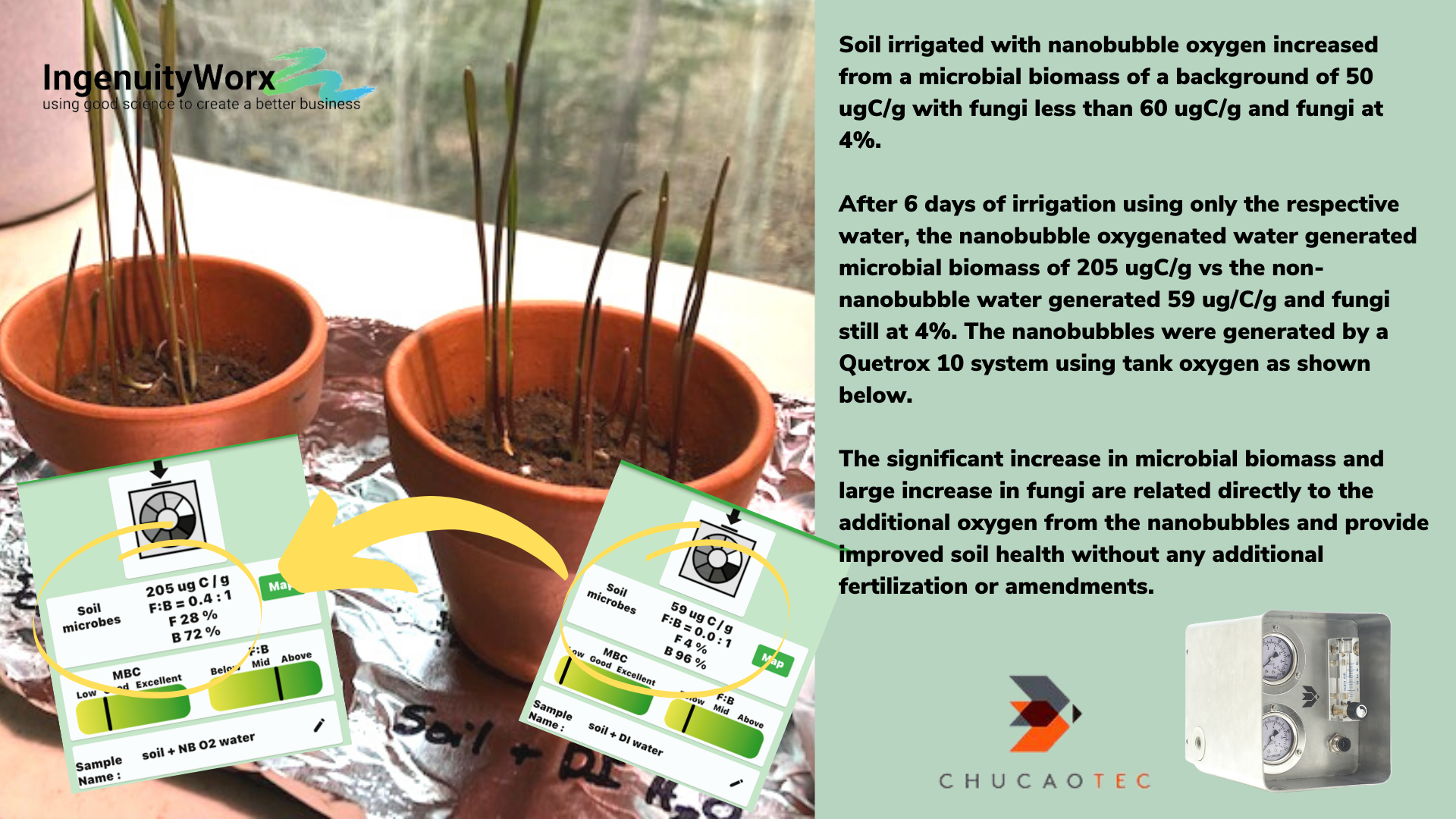
IngenuityWorx has been working to prove that the application of nanobubble oxygen as an irrigation/fertigation tool can provide low cost, easily applied plant benefits both indoors and outdoors.
It has been known for over 40 years that increased oxygen to plant roots in soil improves nutrient absorption, reduces effects of saline water or sodic soils, and increases plant growth and yields. However, traditional aeration technology prevented its use. Aerated water was limited to very short application duration and limited travel time in an irrigation line with low oxygen transfer efficiency.
The new science of nanobubbles allows us to add high dissolved oxygen concentrations, reaching 30-50 ppm, and the oxygen transfer will continue to take place for weeks. The nanobubbles don’t coalesce and break like macro bubbles, they move within the water using Brownian motion, and upon giving up all their oxygen produce small amounts of reactive oxygen species including hydrogen peroxide. This feature provides a built-in cleaning process that removes biofilm.
The microBIOMETER® analysis here shows that high dissolved oxygen in the irrigation water stimulated the microbial biomass and fungi to increase in number indicating a healthy microbiome in the soil for plant growth.
Additional work is ongoing to measure and understand the effects of the oxygenated water and microbial increases as it relates to soil carbon utilization, and its impact on carbon reserves and available nutrients. For more information, please contact bo*@***********rx.com.

This is an abridged version of Dr. Judith Fitzpatrick’s talk at last December’s Acres U.S.A. Eco-Ag conference. Article also featured in the April 2022 issue of Acres U.S.A. magazine.
When a grower first goes organic, they often have one field that’s organic and, right next to it, a field that they’ve been farming conventionally. They run out and test the soil for microbial biomass, and then they write to us and say, “I don’t have any more microbes in my organic field than had in my conventional field.” Why?
It’s because, as a farmer, you have a big, big job when you transition to organic. What you have to have is microbes working for you, and they take time to re-establish after years of conventional farming. We’re all familiar with the food web, but what the conventional pyramid doesn’t communicate is that the microbial base constitutes greater than 95 percent of the food web biomass because all the life above it depends on this food source.
You can view the plant-microbe relationship as a marriage. Each one has a role to play, and they support each other. The plant delivers 30 to 50 percent of the food that it makes to the microbes in the soil in an organic system, and the microbes synthesize and mine the nutrients in the soil and deliver them to the plant. This is a marketplace.
A key player in the marketplace are the arbuscular mycorrhizal fungi. Arbuscular means “room” or “little house.” Arbuscular mycorrhizal fungi actually live — part of them — inside the plant. Outside of the plant they’re picking up phosphorus, nitrogen, potassium, sulfur, and other minerals. When these are transported to the plant, the fungi trade them for the carbon they need — 50 percent of the dried weight of microbes is carbon, as all organic molecules are carbon based.
Arbuscular mycorrhizal fungi hyphae also connect them to other plants. This is especially true in forests. Scientists have shown that arbuscular mycorrhizae will give more phosphorus and other minerals to the plant that gives it more carbon. And they are key players in disease prevention.
The plant-microbe symbiosis is a sophisticated system based on needing each other. In conventional agriculture, you feed the plants directly with chemicals; the plant does not need microbes, so it does not nurture them, and you have a microbe-deficient soil. Microbes do more than feed the plant the nutrients you used as fertilizer, or that they manufacture — they build soil structure, support plant immunity and mine micronutrients in the soil for your plant. When you don’t rely on chemicals, you’re going to be reliant on microbes to feed your plant, and the microbes will build soil structure, mine nutrients for the plant and protect them from pathogens.
We have recently discovered that rhizophagy is an important way that bacteria deliver nutrients to plants. The plant puts out exudates that bring in the microbes it wants to inhabit the rhizosphere. These microbes are often referred to as plant-growth-promoting bacteria because they stimulate plant growth. Bacteria in the rhizosphere enter the root. As they migrate up the root, about 40 percent of their nutrients are extracted by the plant. In return, the plant gives them carbon and forms root hairs through which the bacteria can reenter the soil. Dr. James White has shown that plants that do not have these plant-growth promoting bacteria do not form these important root hairs. He has also shown — and other studies have shown too — that a plant can get 40 percent of its nitrogen, as well as other nutrients, through rhizophagy.
Conventional farming replaces the need for microbes by giving plants NPK, etc. What happens to your plant when you do this? If you put down nitrogen, you do not get the same amount of root growth as when the plant and microbes have nurtured the root. If the plant doesn’t need nitrogen, it doesn’t feed the microbes as much. It’s devastating. When you consider putting on nitrate and ammonium, think about the effect on the root and all the important contributions roots make to soil — e.g., plant stability and fertilizer.
When you go organic, or when you’re maintaining it, your job is to continue to either improve this broken marriage or to maintain it. If the land has been farmed conventionally, you have four big problems: poor soil, a decimated microbial population, a poor crop-microbe fit, and depleted soil organic matter or carbon stores — 50 percent of the carbon that was stored in our soil has been lost.
We’re stuck growing our microbes in a poor soil environment in which they’ve lost their homes. Microbes live on sticky pieces of soil and within aggregates. They multiply inside the aggregates, and in there they are protected from grazers like amoeba. These aggregates are formed by tiny roots and by fungi, providing microbial homes. They are what makes a healthy soil structure, because they allow soil to hold air and water and to prevent erosion. They’re not steady; they can go away if microbes and plant are not continually rebuilding them. In soils that have been chemically treated for years, you do not have good soil structure — you have eroded, compacted soil.

BUILDING SOIL STRUCTURE
How do the microbes build soil structure? A microbe has to attach to the soil — otherwise it will wash away, the same way chemical nutrients do. So, it secretes sticky substances. The best sticky substance is made by fungi. It’s called glomalin. These sticky substances are nutrient rich, and they allow the microbe to stick to the soil. They are very long lasting — even after the microbe dies, these sticky substances stay around, and they cause the particles of soil to stick to one another. They’re what build your soil structure. By increasing your microbes, you’re increasing your soil structure.
Depleted carbon stores also reduce food security for microbes and, by extension, plants. Microbes make soil organic matter (SOM) from the plant material. Plant roots are a very rich source of SOM for soil. That’s why cover crops work so well — they not only nurture microbes and protect the soil surface from erosion, but they’re great for building SOM. The dead roots are an excellent food source for microbes, and the digested material becomes attached to mineral surfaces. When the microbes die, they also become humus.
It’s a relatively recent understanding that 60 percent or more of the SOM that we call humus is actually the bodies of dead microbes. The rest is material that’s been digested by microbes. So, it’s going to be impossible to increase your SOM without increasing your microbes. Increasing your SOM is important because the SOM is the best indicator of plant health.
You can put down a meal like sugar— a lot of the amendments you put down are basically just sugars — that will cause the microbial population to expand. But if there’s not backup food sources from the generations of microbes that came before, or a slowly digestible fertilizer source, the population quickly dies off. It’s like giving a kid candy — it’s not going to build muscle. The amount of microbial biomass correlates very closely with the SOM that’s available to the microbes in that soil, in both humus and recently supplied fertilizer foods.
The number of bacteria in the rhizosphere is going to be much higher than in the surrounding soil, but it’s the surrounding soil that you measure most of the time. I call that the suburbs. The suburbs reflect much of what’s going on in the rhizosphere, but with a lower population. In a bare field, the microbial population is way down. This is one of the reasons that your cover crop is so important. Cover crops help maintain the plant-microbe process, so the microbial population is maintained and SOM increases to provide the carbon and other nutrients that your plant’s microbes will need for the coming cash crop.
Bacteria have about one one-thousandth of the DNA that we have. So, for most of their functions, they’re depending on molecules produced by other microbes. Every cell in your body — every cell in the world — is a gated community. Air and water can go in and out, but absolutely everything else has a receptor. Your microbes are very picky eaters because they have few receptors and few enzymes for digestion. We can only grow about 1 percent of soil microbes in the lab because you have to find out exactly all the different things that you have to provide for that one particular bacteria to grow.
If I take soil and plate it in the lab, the next day I might see one or two colonies. But if I let it go a couple of months, many different colonies start popping up — one today, another tomorrow — all different colonies. One needs another. We don’t yet know the nutritional requirements of all these different bacteria. What we do know is the system is self-sustaining, as one microbe starts to flourish and creates the food another microbe needs; then that microbe starts flourishing, and the chain continues. That is why a soil amendment that feeds the microbes is so effective. They start the process and allow the natural system to start to rebalance itself. This is also why microbial diversity increases as microbial biomass increases, as evidenced by the fact that the fungal population tends to increase in step with the increase in microbial biomass.
Just because you put down a bacteria in the soil doesn’t mean that it has a community that can support it. It’s like taking anybody with one talent and putting them in a community. There may not be the need for their talent, and there may not be the resources that they need in order to function.
Another thing that we’re just beginning to learn is that many currently used cash crops have been bred to thrive under conventional farming practice and have lost the ability to effectively communicate with microbes. This further complicates the transition to regenerative farming and encourages farmer dependance on chemical fertilizers. Now scientists are crossbreeding with some of the older species and increasing the synergism between the microbe and the plant. They’ve been able to get nice increases in productivity when they do that, because regenerative growers are dependent on microbes to deliver the nutrients the plant needs.
When farming chemically, the lab provides an NPK formula. For implementing regenerative farming, you guys have been the pioneers and the researchers, because there is no formula for this — every healthy soil develops a population of microbes that is unique to your soil, climate and crops. Even down the road from one another, people have different soils. To a great extent, you farmers are the underrecognized regenerative researchers.

DIFFERENT MICROBES FOR DIFFERENT SOILS
It’s amazing what different cover crops do for different soils. A group in New York City planted different cover crops in 6-inch pots of soil from an abandoned lot, where the microbial biomass was very low. After three weeks they looked at the soil microbial biomass. There was a tremendous difference in the number of microbes that could be measured in just a few weeks. Clover gave almost a 600 percent increase. In this case, wheatgrass was much lower. We’ve done studies with the University of Tennessee; there, hairy vetch was the winner. They have different soil, and they were growing cotton.
The point is that your soil is going to react differently with every cover crop. I spoke one time at a potato conference, and I said, “We really should have a place where farmers could just send in a piece of their soil and say to the lab, ‘I want to grow this; what cultivar should I use, and what cover crop should I use, and what actually works with my soil?’” At the end of my talk, everyone said, “Where do I send my soil?” I said, “Unfortunately, there is no place you can send your soil to have that work done. But it would be nice.” Also, as farmers know, growing and experimenting inside is not the same as outside.
ESTABLISHING OPTIMAL MICROBIAL BIOMASS
A lot of people ask us, what affects the microbe level I am measuring? Number one is moisture. We only test soils that are fresh, field-moist samples. They will contain as much as four times as many microbes as dried soil. If we revive a dried soil in the laboratory, the population of microbes is different in composition, and often in biomass, than that same population in field-moist soil. We especially see a big difference in the fungal-to-bacterial ratio because fungi seem to be more susceptible to drying out. We developed our on-site test at the suggestion of James Sottilo, one of our founders, who said, “I can’t send my samples to a lab. It’s like sending a body to a lab and asking how it’s doing after it’s been three days in the U.S. Post Office. And I need an answer now —not in two weeks.”
Microbe levels are also dependent on adequate nutrient levels, favorable pH and low compaction. If you have compacted soil, there’s not enough oxygen in it, so your microbial biomass will be low. Any disruption, like tilling, can greatly affect your microbial biomass. Temperature, salt and other chemicals affect microbial diversity and your crop. Other experiments have shown that as temperature goes up, microbial biomass goes down — but respiration, which indicates activity, goes up.
Microbial biomass varies over the season. Different test systems give quite different results, so you should stick with one system for monitoring. Interestingly, in spring, when the plant first wakes up and puts out a big boost to stimulate the microbes, we see a doubling of the microbial biomass, which then drops down. That’s called the priming effect. A fertilizer can also have a priming effect.
It is very important that after a priming effect there is sufficient food for the microbes that have been stimulated. For most soils, this requires that the fertilizer have the correct C:N ratio for the soil and crop. A fertilizer with too high a C:N ratio will boost respiration, which means the carbon is being released as CO2, but it will not allow the microbes to store the C in the organic carbon compounds that the microbes need to nourish the plant and build soil structure.
Microbial respiration — the amount of carbon dioxide released by a given weight of soil — is a measure of microbial activity and is not necessarily correlated with microbial biomass. These two measurements tell you two different things. The most important information you can get from testing is what is called the metabolic quotient (q). The q number = respiration / microbial biomass. If respiration of a given microbial biomass is higher than it should be, your fertilizer is being released into the air and not helping your microbes and plants to grow. Luckily, the fungal-to bacterial ratio correlates almost perfectly with q and tells you that you’re building fertility, not releasing it into the air as CO2.
In an organic or sustainable system, you’re entirely or largely dependent on the microbial community for immunity to pathogens. I can’t emphasize enough that the immune system of the plant is microbial. If the plant gets an infection of its leaves, it sends a message to the
root to bring in the bacteria that makes the antibiotic that it needs to fight that infection. If you don’t have those microbes, you can’t do that. Plants, like people, need to be exposed to a whole variety of microbes — not just good microbes. A huge study in Europe showed that organic farms required 97 percent fewer pesticides of any sort. What a gain in cost savings and food health!
Plants need to be exposed to and learn the ways of bad microbes. Organically grown plants develop 2,000 antioxidant compounds that are not in plants that are grown non-organically with chemicals. Those antioxidants protect the plant and when ingested provide protection against inflammation, cancer, etc. In addition, it is these antioxidants that plants make to defend themselves against disease that give microbially nourished plants the flavors that make them so much more desirable.
Your plant is also dependent on microbes for its required minerals and nitrogen, for digesting litter to increase soil matter, for providing information about soil conditions that allow the plant to adapt and for creating soil structure that increases water holding capacity — when you have an adequate microbial population, you increase your water holding capacity by 50 percent. Microbes also increase soil structure — protecting soil from erosion while building soil organic matter. It is important to point out here that soil organic carbon is what is measured, but it is stored in SOM — molecules containing NPK and all the other nutrients plants need.
The key to transitioning, then, is to provide the environment that will allow your microbial community to rebuild itself. There’s no formula for it. The right formula will depend on your soil, your climate and your crops. We know that the microbial community can do this by itself, given the right foods and opportunity. And you can tell if you’re going in the right direction by measuring microbial biomass and fungal-to-bacterial ratio.