

Seasonal dynamics are a major driver of soil microbial communities. Much like you and I, microbes are more active during some seasons, and more dormant during others. This can be attributed to the different responses microbes have to nutrient inputs, climatic conditions, and other soil properties. As there are a lot of factors that affect microbial activity, it can be difficult for farmers or researchers to make definitive statements regarding the relationship between their soil microbial communities and seasonal changes. Specifically, temperature, moisture content, and the existence of plant life are considered the most important factors affecting microbial growth and activity within a season.
The presence of plants on the soil has a large impact on microbial life. As plants form, they begin to cultivate microbes surrounding their roots by producing nutrients for the microbes to essentially feed on. As the microbial community grows, they undergo a series of processes allowing them to obtain nitrogen and mineral nutrients from the soil and then provide the nutrients back to the plant to stimulate growth. This is part of the symbiotic relationship between plants and microbes– they support each other through the mining of nutrients from the soil and sun.
Just like plant presence, temperature greatly influences soil microbial properties. During cold seasons, temperature is considered a major limiting factor of microbial activity, whereas water availability could be a limiting factor during the summer season. Soil temperature can affect organic matter decomposition and mineralization rates, thereby impacting microbial biomass and activity levels. Bare soil, or soil without any plants growing, will have lower microbial activity occurring, regardless of season. This is why researchers and land stewards have emphasized the planting of cover crops between growing seasons in regenerative agriculture– as cover crops can alter soil properties and increase the biomass and diversity of microbial communities. In the warmer or hotter seasons, the addition of cover crops can also help to mitigate how much heat the soil is absorbing.
Studies show that microbial activity in agricultural soils increases in the fall when compared to other growing seasons–likely due to an increased level of nutrients and soil organic matter from crop and plant residue post harvest. Throughout the wintertime, or non growing season, microbial activity and composition is thought to be stagnant, but stable. An increase in microbial activity is said to occur after the thawing of frozen soils and can be linked to the freeze-thaw cycle (FTC) that colder climates experience. As snow freezes over soil, it inhibits air diffusion from occurring, creating anaerobic conditions for the microbial communities and therefore altering the soil community structure. In turn, this causes an increase in denitrification, respiration, and production of greenhouse gases, which are being trapped under the frozen layer. Once temperatures begin to rise, the soil begins to thaw, allowing oxygen into the soil. This provides labile carbon and other nutrients to the soil, which increases microbial activity and biomass. However, once thawing occurs, those greenhouse gases that were once trapped, are released into the air. This exact dynamic between microbial activity and the FTC is still being debated due to different soil properties greatly affecting freeze/thaw rates and as researchers use different methodologies, making it difficult to compare results between studies.
But despite the controversy surrounding the exact relationship between microbes and seasonal temperature changes, researchers do agree that microbial biomass and activity are related to seasonal temperature fluctuations. They’ve found that generally, microbial biomass decreases once the temperature increases past a certain point. As temperature increases, there is also an increase in CO2 being released from the soil, which we refer to as respiration. So when more respiration occurs, more carbon is being put into the air. This respiration process is sensitive to temperature change, which is why it’s imperative to have a better understanding of the seasonal dynamics of microbial communities.
As soil microbial life varies naturally by season, it might be hard to differentiate the natural seasonal changes from the changes related to your regenerative growing practices. Understanding the short term seasonal dynamics of microbial communities in various soil conditions is key in furthering our understanding of soil biology. Documenting and analyzing periodic readings with microBIOMETER® can assist you in differentiating between natural and seasonal changes in your soil.
References:
Bates, Todd B. (2018, Oct 10). How Plants Harness Microbes to Get Nutrients. Rutgers.edu.
https://www.rutgers.edu/news/how-plants-harness-microbes-get-nutrients
Bizzell, E. (2018, April 16). Plants and the bacteria at the root of it all. ASM.org.
https://asm.org/Articles/2018/April/plants-and-the-bacteria-at-the-root-of-it-all
Gao H, Tian G, Khashi u Rahman M and Wu F (2022) Cover Crop Species Composition Alters the
Soil Bacterial Community in a Continuous Pepper Cropping System. Frontier Microbiology. 12:789034.
Jensen G, Krogstad K, Rezanezhad F and Hug LA (2022) Microbial Community Compositional
Stability in Agricultural Soils During Freeze-Thaw and Fertilizer Stress. Frontier Environmental Science. 10:908568.
McDaniel, M. D. and Grandy, A. S.: Soil microbial biomass and function are altered by 12 years of
crop rotation, SOIL, 2, 583–599, (2016).
onwuka B, Mang B. (2018) Effects of soil temperature on some soil properties and plant growth.
Adv Plants Agric Res. 8(1):34-37
Pietikäinen, J., Pettersson, M., & Bååth, E. (2005). Comparison of temperature effects on soil
respiration and bacterial and fungal growth rates. FEMS Microbiology Ecology, 52(1), 49–58.
Simon, E., Canarini, A., Martin, V. et al. Microbial growth and carbon use efficiency show seasonal
responses in a multifactorial climate change experiment. Communicati
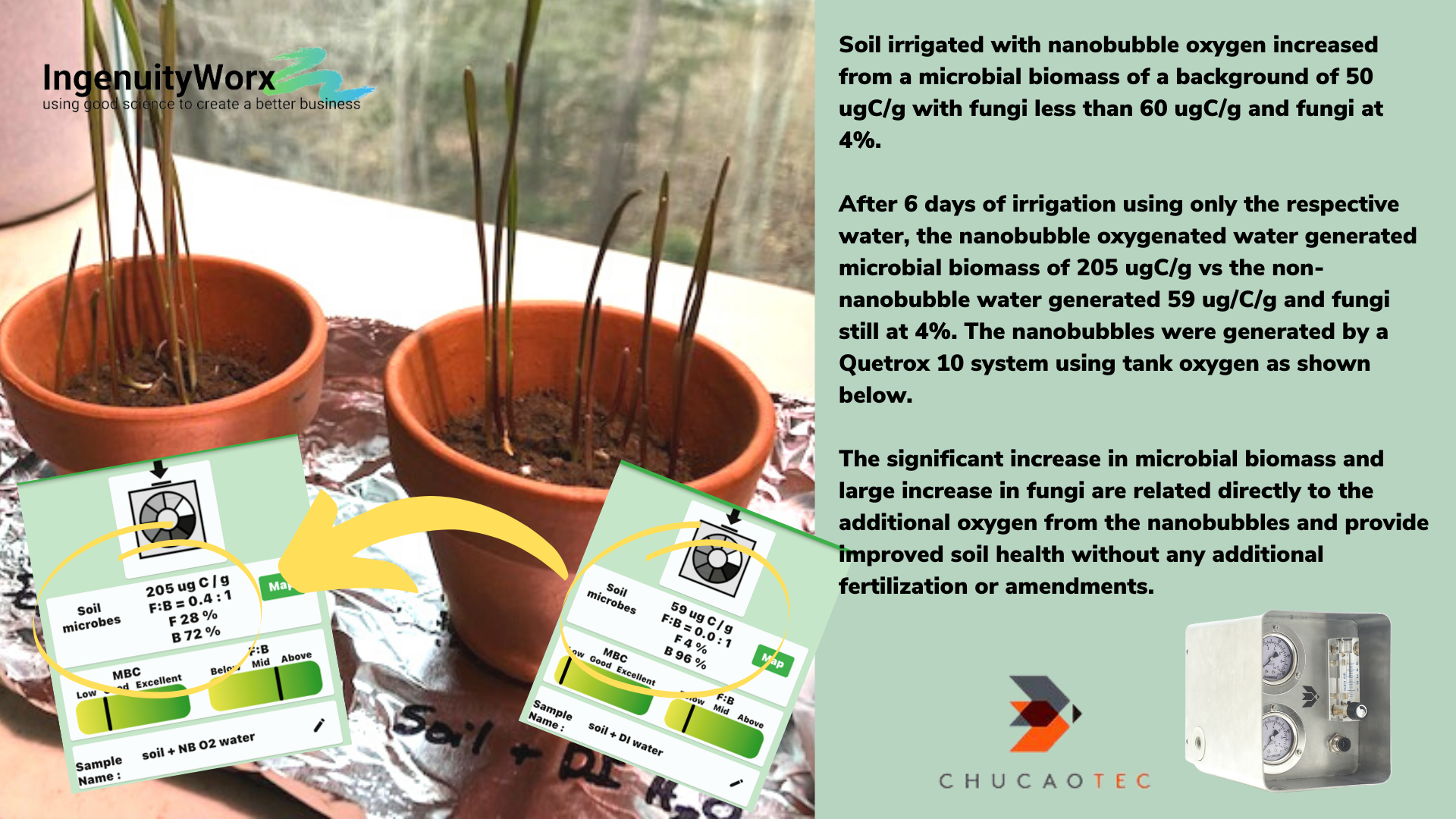
IngenuityWorx has been working to prove that the application of nanobubble oxygen as an irrigation/fertigation tool can provide low cost, easily applied plant benefits both indoors and outdoors.
It has been known for over 40 years that increased oxygen to plant roots in soil improves nutrient absorption, reduces effects of saline water or sodic soils, and increases plant growth and yields. However, traditional aeration technology prevented its use. Aerated water was limited to very short application duration and limited travel time in an irrigation line with low oxygen transfer efficiency.
The new science of nanobubbles allows us to add high dissolved oxygen concentrations, reaching 30-50 ppm, and the oxygen transfer will continue to take place for weeks. The nanobubbles don’t coalesce and break like macro bubbles, they move within the water using Brownian motion, and upon giving up all their oxygen produce small amounts of reactive oxygen species including hydrogen peroxide. This feature provides a built-in cleaning process that removes biofilm.
The microBIOMETER® analysis here shows that high dissolved oxygen in the irrigation water stimulated the microbial biomass and fungi to increase in number indicating a healthy microbiome in the soil for plant growth.
Additional work is ongoing to measure and understand the effects of the oxygenated water and microbial increases as it relates to soil carbon utilization, and its impact on carbon reserves and available nutrients. For more information, please contact bo*@***********rx.com.

This is an abridged version of Dr. Judith Fitzpatrick’s talk at last December’s Acres U.S.A. Eco-Ag conference. Article also featured in the April 2022 issue of Acres U.S.A. magazine.
When a grower first goes organic, they often have one field that’s organic and, right next to it, a field that they’ve been farming conventionally. They run out and test the soil for microbial biomass, and then they write to us and say, “I don’t have any more microbes in my organic field than had in my conventional field.” Why?
It’s because, as a farmer, you have a big, big job when you transition to organic. What you have to have is microbes working for you, and they take time to re-establish after years of conventional farming. We’re all familiar with the food web, but what the conventional pyramid doesn’t communicate is that the microbial base constitutes greater than 95 percent of the food web biomass because all the life above it depends on this food source.
You can view the plant-microbe relationship as a marriage. Each one has a role to play, and they support each other. The plant delivers 30 to 50 percent of the food that it makes to the microbes in the soil in an organic system, and the microbes synthesize and mine the nutrients in the soil and deliver them to the plant. This is a marketplace.
A key player in the marketplace are the arbuscular mycorrhizal fungi. Arbuscular means “room” or “little house.” Arbuscular mycorrhizal fungi actually live — part of them — inside the plant. Outside of the plant they’re picking up phosphorus, nitrogen, potassium, sulfur, and other minerals. When these are transported to the plant, the fungi trade them for the carbon they need — 50 percent of the dried weight of microbes is carbon, as all organic molecules are carbon based.
Arbuscular mycorrhizal fungi hyphae also connect them to other plants. This is especially true in forests. Scientists have shown that arbuscular mycorrhizae will give more phosphorus and other minerals to the plant that gives it more carbon. And they are key players in disease prevention.
The plant-microbe symbiosis is a sophisticated system based on needing each other. In conventional agriculture, you feed the plants directly with chemicals; the plant does not need microbes, so it does not nurture them, and you have a microbe-deficient soil. Microbes do more than feed the plant the nutrients you used as fertilizer, or that they manufacture — they build soil structure, support plant immunity and mine micronutrients in the soil for your plant. When you don’t rely on chemicals, you’re going to be reliant on microbes to feed your plant, and the microbes will build soil structure, mine nutrients for the plant and protect them from pathogens.
We have recently discovered that rhizophagy is an important way that bacteria deliver nutrients to plants. The plant puts out exudates that bring in the microbes it wants to inhabit the rhizosphere. These microbes are often referred to as plant-growth-promoting bacteria because they stimulate plant growth. Bacteria in the rhizosphere enter the root. As they migrate up the root, about 40 percent of their nutrients are extracted by the plant. In return, the plant gives them carbon and forms root hairs through which the bacteria can reenter the soil. Dr. James White has shown that plants that do not have these plant-growth promoting bacteria do not form these important root hairs. He has also shown — and other studies have shown too — that a plant can get 40 percent of its nitrogen, as well as other nutrients, through rhizophagy.
Conventional farming replaces the need for microbes by giving plants NPK, etc. What happens to your plant when you do this? If you put down nitrogen, you do not get the same amount of root growth as when the plant and microbes have nurtured the root. If the plant doesn’t need nitrogen, it doesn’t feed the microbes as much. It’s devastating. When you consider putting on nitrate and ammonium, think about the effect on the root and all the important contributions roots make to soil — e.g., plant stability and fertilizer.
When you go organic, or when you’re maintaining it, your job is to continue to either improve this broken marriage or to maintain it. If the land has been farmed conventionally, you have four big problems: poor soil, a decimated microbial population, a poor crop-microbe fit, and depleted soil organic matter or carbon stores — 50 percent of the carbon that was stored in our soil has been lost.
We’re stuck growing our microbes in a poor soil environment in which they’ve lost their homes. Microbes live on sticky pieces of soil and within aggregates. They multiply inside the aggregates, and in there they are protected from grazers like amoeba. These aggregates are formed by tiny roots and by fungi, providing microbial homes. They are what makes a healthy soil structure, because they allow soil to hold air and water and to prevent erosion. They’re not steady; they can go away if microbes and plant are not continually rebuilding them. In soils that have been chemically treated for years, you do not have good soil structure — you have eroded, compacted soil.

BUILDING SOIL STRUCTURE
How do the microbes build soil structure? A microbe has to attach to the soil — otherwise it will wash away, the same way chemical nutrients do. So, it secretes sticky substances. The best sticky substance is made by fungi. It’s called glomalin. These sticky substances are nutrient rich, and they allow the microbe to stick to the soil. They are very long lasting — even after the microbe dies, these sticky substances stay around, and they cause the particles of soil to stick to one another. They’re what build your soil structure. By increasing your microbes, you’re increasing your soil structure.
Depleted carbon stores also reduce food security for microbes and, by extension, plants. Microbes make soil organic matter (SOM) from the plant material. Plant roots are a very rich source of SOM for soil. That’s why cover crops work so well — they not only nurture microbes and protect the soil surface from erosion, but they’re great for building SOM. The dead roots are an excellent food source for microbes, and the digested material becomes attached to mineral surfaces. When the microbes die, they also become humus.
It’s a relatively recent understanding that 60 percent or more of the SOM that we call humus is actually the bodies of dead microbes. The rest is material that’s been digested by microbes. So, it’s going to be impossible to increase your SOM without increasing your microbes. Increasing your SOM is important because the SOM is the best indicator of plant health.
You can put down a meal like sugar— a lot of the amendments you put down are basically just sugars — that will cause the microbial population to expand. But if there’s not backup food sources from the generations of microbes that came before, or a slowly digestible fertilizer source, the population quickly dies off. It’s like giving a kid candy — it’s not going to build muscle. The amount of microbial biomass correlates very closely with the SOM that’s available to the microbes in that soil, in both humus and recently supplied fertilizer foods.
The number of bacteria in the rhizosphere is going to be much higher than in the surrounding soil, but it’s the surrounding soil that you measure most of the time. I call that the suburbs. The suburbs reflect much of what’s going on in the rhizosphere, but with a lower population. In a bare field, the microbial population is way down. This is one of the reasons that your cover crop is so important. Cover crops help maintain the plant-microbe process, so the microbial population is maintained and SOM increases to provide the carbon and other nutrients that your plant’s microbes will need for the coming cash crop.
Bacteria have about one one-thousandth of the DNA that we have. So, for most of their functions, they’re depending on molecules produced by other microbes. Every cell in your body — every cell in the world — is a gated community. Air and water can go in and out, but absolutely everything else has a receptor. Your microbes are very picky eaters because they have few receptors and few enzymes for digestion. We can only grow about 1 percent of soil microbes in the lab because you have to find out exactly all the different things that you have to provide for that one particular bacteria to grow.
If I take soil and plate it in the lab, the next day I might see one or two colonies. But if I let it go a couple of months, many different colonies start popping up — one today, another tomorrow — all different colonies. One needs another. We don’t yet know the nutritional requirements of all these different bacteria. What we do know is the system is self-sustaining, as one microbe starts to flourish and creates the food another microbe needs; then that microbe starts flourishing, and the chain continues. That is why a soil amendment that feeds the microbes is so effective. They start the process and allow the natural system to start to rebalance itself. This is also why microbial diversity increases as microbial biomass increases, as evidenced by the fact that the fungal population tends to increase in step with the increase in microbial biomass.
Just because you put down a bacteria in the soil doesn’t mean that it has a community that can support it. It’s like taking anybody with one talent and putting them in a community. There may not be the need for their talent, and there may not be the resources that they need in order to function.
Another thing that we’re just beginning to learn is that many currently used cash crops have been bred to thrive under conventional farming practice and have lost the ability to effectively communicate with microbes. This further complicates the transition to regenerative farming and encourages farmer dependance on chemical fertilizers. Now scientists are crossbreeding with some of the older species and increasing the synergism between the microbe and the plant. They’ve been able to get nice increases in productivity when they do that, because regenerative growers are dependent on microbes to deliver the nutrients the plant needs.
When farming chemically, the lab provides an NPK formula. For implementing regenerative farming, you guys have been the pioneers and the researchers, because there is no formula for this — every healthy soil develops a population of microbes that is unique to your soil, climate and crops. Even down the road from one another, people have different soils. To a great extent, you farmers are the underrecognized regenerative researchers.

DIFFERENT MICROBES FOR DIFFERENT SOILS
It’s amazing what different cover crops do for different soils. A group in New York City planted different cover crops in 6-inch pots of soil from an abandoned lot, where the microbial biomass was very low. After three weeks they looked at the soil microbial biomass. There was a tremendous difference in the number of microbes that could be measured in just a few weeks. Clover gave almost a 600 percent increase. In this case, wheatgrass was much lower. We’ve done studies with the University of Tennessee; there, hairy vetch was the winner. They have different soil, and they were growing cotton.
The point is that your soil is going to react differently with every cover crop. I spoke one time at a potato conference, and I said, “We really should have a place where farmers could just send in a piece of their soil and say to the lab, ‘I want to grow this; what cultivar should I use, and what cover crop should I use, and what actually works with my soil?’” At the end of my talk, everyone said, “Where do I send my soil?” I said, “Unfortunately, there is no place you can send your soil to have that work done. But it would be nice.” Also, as farmers know, growing and experimenting inside is not the same as outside.
ESTABLISHING OPTIMAL MICROBIAL BIOMASS
A lot of people ask us, what affects the microbe level I am measuring? Number one is moisture. We only test soils that are fresh, field-moist samples. They will contain as much as four times as many microbes as dried soil. If we revive a dried soil in the laboratory, the population of microbes is different in composition, and often in biomass, than that same population in field-moist soil. We especially see a big difference in the fungal-to-bacterial ratio because fungi seem to be more susceptible to drying out. We developed our on-site test at the suggestion of James Sottilo, one of our founders, who said, “I can’t send my samples to a lab. It’s like sending a body to a lab and asking how it’s doing after it’s been three days in the U.S. Post Office. And I need an answer now —not in two weeks.”
Microbe levels are also dependent on adequate nutrient levels, favorable pH and low compaction. If you have compacted soil, there’s not enough oxygen in it, so your microbial biomass will be low. Any disruption, like tilling, can greatly affect your microbial biomass. Temperature, salt and other chemicals affect microbial diversity and your crop. Other experiments have shown that as temperature goes up, microbial biomass goes down — but respiration, which indicates activity, goes up.
Microbial biomass varies over the season. Different test systems give quite different results, so you should stick with one system for monitoring. Interestingly, in spring, when the plant first wakes up and puts out a big boost to stimulate the microbes, we see a doubling of the microbial biomass, which then drops down. That’s called the priming effect. A fertilizer can also have a priming effect.
It is very important that after a priming effect there is sufficient food for the microbes that have been stimulated. For most soils, this requires that the fertilizer have the correct C:N ratio for the soil and crop. A fertilizer with too high a C:N ratio will boost respiration, which means the carbon is being released as CO2, but it will not allow the microbes to store the C in the organic carbon compounds that the microbes need to nourish the plant and build soil structure.
Microbial respiration — the amount of carbon dioxide released by a given weight of soil — is a measure of microbial activity and is not necessarily correlated with microbial biomass. These two measurements tell you two different things. The most important information you can get from testing is what is called the metabolic quotient (q). The q number = respiration / microbial biomass. If respiration of a given microbial biomass is higher than it should be, your fertilizer is being released into the air and not helping your microbes and plants to grow. Luckily, the fungal-to bacterial ratio correlates almost perfectly with q and tells you that you’re building fertility, not releasing it into the air as CO2.
In an organic or sustainable system, you’re entirely or largely dependent on the microbial community for immunity to pathogens. I can’t emphasize enough that the immune system of the plant is microbial. If the plant gets an infection of its leaves, it sends a message to the
root to bring in the bacteria that makes the antibiotic that it needs to fight that infection. If you don’t have those microbes, you can’t do that. Plants, like people, need to be exposed to a whole variety of microbes — not just good microbes. A huge study in Europe showed that organic farms required 97 percent fewer pesticides of any sort. What a gain in cost savings and food health!
Plants need to be exposed to and learn the ways of bad microbes. Organically grown plants develop 2,000 antioxidant compounds that are not in plants that are grown non-organically with chemicals. Those antioxidants protect the plant and when ingested provide protection against inflammation, cancer, etc. In addition, it is these antioxidants that plants make to defend themselves against disease that give microbially nourished plants the flavors that make them so much more desirable.
Your plant is also dependent on microbes for its required minerals and nitrogen, for digesting litter to increase soil matter, for providing information about soil conditions that allow the plant to adapt and for creating soil structure that increases water holding capacity — when you have an adequate microbial population, you increase your water holding capacity by 50 percent. Microbes also increase soil structure — protecting soil from erosion while building soil organic matter. It is important to point out here that soil organic carbon is what is measured, but it is stored in SOM — molecules containing NPK and all the other nutrients plants need.
The key to transitioning, then, is to provide the environment that will allow your microbial community to rebuild itself. There’s no formula for it. The right formula will depend on your soil, your climate and your crops. We know that the microbial community can do this by itself, given the right foods and opportunity. And you can tell if you’re going in the right direction by measuring microbial biomass and fungal-to-bacterial ratio.
A teaspoon of healthy soil contains billions of microbes.
Microbes feed the plants, strengthen their roots, and increase their yields. A plant sends signals to attract the microbes it needs at any given moment. In chemical-free agriculture, there is a good marriage between plants and microbes. In a complex, self-regulating system, plants and microbes work harmoniously, nourishing each other.
The chemistry of a plant sends specific nutrients to attract microbes to strengthen its immunity. The plant is not only capable of diagnosing its needs, it also makes its own medicine. When chemicals interfere with self-regulation, the plants are weakened. What should you do to improve the health of your plants? Build your microbial biomass by building your soil. Soil structure is the microbial home. A couple ways to build your soil structure are composting and cover crops. The roots in the soil are home to microbes. In nature, soil is covered, not fallow. The global soil degradation and desertification affects us all.
The microbes found in soil are also found in our gut. The health of the soil impacts the nutritional value of our food and our health. The immunity of a plant impacts our own immunity. What we eat is essential to our own wellbeing. By taking care of the land and our agriculture, we are also taking care of ourselves. In this interview with Dr. Judy Fitzpatrick, microbiologist and diagnostic developer, we deepen into the importance of microbial biomass, the ratio of fungi to bacteria, plant – and human – immunity, and how to build soil
structure.
This article was featured in the April 2022 issue of Heart & Soil Magazine Rooted in Wisdom.
Click here to listen to the full interview on Heart & Soil TV.
 Janet Atandi, a nematology PhD student in Kenya, is currently working on an assessment of banana fiber paper on soil health as part of a Wrap and Plant technology study. In brief, she is testing the long-term effect of using modified banana fiber paper to manage plant-parasitic nematodes and its impact on the beneficial soil microbial communities.
The banana fiber paper is used as an organic carrier for either ultra-low dosages of nematicides (abamectin and fluopyram) or microbial antagonists (Trichoderma spp.) and is to be compared to unmodified paper.
This study is being conducted using potatoes and green peas as the test crops over five consecutive seasons. With the aid of a microBIOMETER® test kit, Janet will be able to assess the impact of the paper on the soil microbial biomass and thus will be able to determine whether the banana paper is effective or detrimental to soil health.
Wrap and Plant technology sources:
NC State explores promising pest-control strategy with high-impact potential for sub-Saharan Africa
Banana’s Waste, potatoes gain
Potato farmers conquer a devastating worm—with paper made from bananas]

University study demonstrates legumes are more efficient at improving soil MBC than grasses
Under the direction of Assistant Professor Denise Finney, Kylie Cherneskie, biology student at Ursinus College, conducted an experiment on the impacts of nitrogen fertilizer addition on soil microbial communities. Kylie measured microbial responses using microBIOMETER®.
Click here to view the finished poster presentation. If you would like to incorporate microBIOMETER® into your classroom studies/academic research, we offer a selection of Academia Classroom Kits.
 Calibration of microBIOMETER® to units of µg microbial carbon / gram soil
The gold standard of laboratory soil microbial biomass testing is Chloroform Fumigation and Extraction (CFE). The multiple steps, time, and labor involved with CFE require pricing at up to $500 per sample. CFE works by comparing the difference of chemically extractable carbon between two portions of a soil sample: One that has been treated to break open microbial cell membranes and expose the carbon-containing biological molecules to extraction, and one that has not. The difference in carbon for the two portions is reported as microbial biomass carbon (MBC), in units of µg C / g soil.
microBIOMETER® is calibrated to the same units by a different method. Estimates of bacterial dry mass converge at around one trillionth (1×10-12) of a gram (1 pg) for a 1 µm bacterium. We measured the area of microbes in known volumes of microBIOMETER® extract (both by manual counting on a hemocytometer and by digital analysis of micrographs) and calculated total microbial mass, which was then converted to µg / g for the whole 0.5 ml sample of soil in the extract. We found that on average, 0.5 ml of soil weighs 0.6 g when fully dried, independent of starting moisture content. The 1 pg dry mass per bacterium is 50% carbon, so we also had to account for that in our calibration.
Here’s an example of the conversion.
Let’s say that in 1×10⁻⁸ liter (10 nl) of microBIOMETER® extract we measured 240 µm2 of microbes. 240 µm2 = 240 bacteria equivalents (BE). 240 BE x 1×10-12 g per BE = 240×10-12 g of dry microbes. The volume of original extract is 10 ml (1 x 10⁻² liter), and 10 nl of microscopically examined extract represents 1×10⁻⁸/1×10-2 = 1×10⁻⁶ of the total mass of the microbes in the extract. So 240×10-12 g microbes / 1×10-6 = 240 x 10-6 g microbes in the whole extract. 50% of the 240 x 10-6 g of microbes is carbon, so we have 120 x 10-6 g microbial carbon. We started with 0.5 ml = 0.6 grams of dried soil in the extraction process, therefore 120 x 10-6 g microbial carbon / 0.6 g soil = 200 x 10-6 g microbial carbon / gram soil, or 200 µg microbial carbon / gram soil.
While we arrived at µg microbial carbon / gram soil through a different method than CFE, it turns out our methods are on par with the CFE test. We compared measurements of µg carbon / gram soil via CFE and microBIOMETER® from 28 soils from across the U.S.
The slope of ~1 of the regression line indicates our units are on par with CFE, and the 94% correlation indicates that users can be confident that the $13.50 or less microBIOMETER® test gives results as accurate and informative as one priced $500.

Nature article reports that microbial biomass estimates by microBIOMETER® correlates with soil health and yield stability.
The microBIOMETER® soil test was used to report microbial biomass in a recent Nature publication*. Scientists Dr. Judith Fitzpatrick and Dr. Brady Trexler of microBIOMETER® collaborated with a University of Tennessee team headed by Dr. Amin Nouri. The team evaluated the effects on soil health and yield stability of 39 different methods of raising cotton over 29 years. The conditions tested included till, no-till, various cover crops and different levels of nitrogen fertilization.
The study found that the major impacts on yield were very dry or wet conditions, and low or high temperatures. The deleterious effects of these weather extremes on yield were mitigated by regenerative agricultural practices which resulted in adequate soil, C, N, soil structure and microbial biomass.
*Nouri, A., Yoder, D.C., Raji, M., Ceylan, S., Jagadamma, S., Lee, J., Walker, F.R., Yin, X., Fitzpatrick, J., Trexler, B. and Arelli, P., 2021. Conservation agriculture increases the soil resilience and cotton yield stability in climate extremes of the southeast US. Communications Earth & Environment, 2(1), pp.1-12.
 Informal science education is a key for community engagement and healthy gardening. Community gardening brings numerous benefits such as fresh produce, therapy, physical exercise, reduction in grocery bills, improvement of mood among many others.
“Last weekend I had the privilege to teach community gardeners on the importance of soil testing side by side with my very first student at NYBG Adult Education program (class 2015). Dr. Joan Basile is a clinical psychologist who has developed her own horticulture therapy program incorporating soil knowledge brining therapy & soil science & gardening together.” – Dr. Anna Paltseva, soil_expert.
⠀
“While the microBIOMETER® results showed there is room for improvement, the result from last year’s beds also proved that composting and mulching practices are paying off in increased soil life. This means that sandy soil will gradually be able to hold nutrients better and better!” – Dr. Basile
 The Biospheres, working through the CDA*, accompanies and trains farmers/agricultural companies in the agroecological transition based on a soil conservation approach. The group is also working on applied research projects and therefore on trials under real farming conditions in which they evaluate the impact of certain changes in practices on different indicators (biological, chemical, physical, economic).
“One of our primary objectives is that farmers succeed in putting biology back into their soils to ensure their natural fertility. We are therefore very interested in everything that lives in the soil, from earthworms and microarthropods to microorganisms (bacteria, fungi, nematodes). For us, microbial biomass is one of the most important indicators that help us understand soil biology. Fungal to bacterial ratio, which is a less documented indicator for the moment, remains interesting to observe in certain situations and is the object of real research by our R&D team to understand how best to interpret it.
We have been using microBIOMETER® for 8 months now to test the soil in different projects in our panel of biological indicators. microBIOMETER® provides us with quick and easy results on microbial biomass and F:B ratio which is a real plus for us. We can perform tests directly in the field and present the results to the farmers. Moreover, the affordable price of the analysis allows us to perform soil biology tests in projects where we had no affordable way to do so before.”
*CDA, Centre de Développement de l’Agroécologie, are affiliates dedicated to R&D and advisory.
