
Fertilizer gives your soil nutrients. Soil microbes decide whether your plants can actually use them. That distinction changes everything about how you should think about crop nutrition, and it’s exactly why we built microBIOMETER®.
Nutrient cycling happens through billions of bacteria and fungi working in your root zone every single day. Skip understanding that process, and you’re managing half the equation.
How Soil Microbes in Nutrient Cycling Actually Work
Soil microbes in nutrient cycling break down organic matter, transform nutrients into plant-available forms, and shuttle them toward root systems. Without this biological activity, nutrients can sit locked in the soil, completely inaccessible to your crops.
Bacteria drive processes like nitrogen fixation, converting atmospheric nitrogen into forms plants can absorb. Fungi, particularly mycorrhizal species, extend root reach dramatically, pulling in phosphorus and water from areas roots alone could never access. Together, these microbial communities form the engine behind soil fertility.
Why Nitrogen Cycling Depends Entirely on Microbial Activity
Nitrogen is the nutrient most crops need in the highest volume, yet it’s also one of the most microbially dependent. Bacteria convert nitrogen gas into ammonium, then into nitrate, through a multi-step biological process called nitrogen cycling.
Without active soil microbes, applied nitrogen fertilizer can volatilize, leach away, or simply sit unused. That’s wasted money and a missed opportunity for your crop.
A healthy microbial population keeps nitrogen cycling efficiently, meaning less fertilizer gets lost and more actually reaches your plants.
Phosphorus Availability and the Fungal Connection
Phosphorus behaves differently than nitrogen. It binds tightly to soil particles, making it one of the least mobile nutrients for plant roots to reach on their own.
This is where beneficial fungi step in. Mycorrhizal fungi form partnerships with plant roots, extending a vast underground network that accesses phosphorus far beyond a root’s natural reach. Crops with strong fungal partnerships consistently show better phosphorus uptake, even in soils where phosphorus levels test as moderate or low.
Signs Your Soil Biology Is Limiting Nutrient Uptake
Sometimes a nutrient deficiency isn’t actually a nutrient problem. It’s a biology problem. Here are common signs your soil microbiome and plant growth connection might be broken:
If any of these signs sound familiar, checking microbial biomass rather than adding more fertilizer might solve the actual problem.
How to Test for Microbial Nutrient Cycling Capacity
Most nutrient testing stops at chemistry. It tells you what’s there, not whether your soil can turn it into something your plants can use.
The microBIOMETER® helps you evaluate your soil’s biological potential by measuring microbial biomass and the fungal-to-bacterial (F:B) ratio in about 20 minutes. These two indicators provide a practical way to assess the strength and balance of the microbial community responsible for nutrient cycling and other essential soil functions.
Rather than relying on a single measurement, you can use microBIOMETER® throughout the season to monitor how cover crops, compost, reduced tillage, biological inputs, or other management practices influence microbial activity. Tracking these changes over time helps you determine whether your soil is becoming more biologically active and better equipped to support efficient nutrient cycling.
A healthier, more active microbial community can improve nutrient availability, helping growers build more resilient soils and reduce reliance on synthetic fertilizers over the long term.
Building Nutrient Efficiency Through Better Soil Biology
Improving nutrient uptake in plants isn’t about applying more inputs. It’s about creating conditions where the soil’s biology can do its job efficiently.
Here’s how growers typically strengthen microbial nutrient cycling:
| Practice | Effect on Nutrient Cycling |
| Reduced tillage | Protects fungal networks that transport phosphorus |
| Cover cropping | Feeds bacteria and boosts nitrogen availability |
| Compost application | Increases overall microbial biomass |
| Diverse crop rotation | Supports broader microbial diversity |
We recommend soil testing before and after implementing these practices. That way you can confirm improved rhizosphere biology instead of assuming it happened.
Why This Matters for Reducing Fertilizer Costs
Fertilizer is expensive, and prices keep climbing. When soil microbes handle nutrient cycling efficiently, plants access more of what’s already in the ground, cutting down how much you need to apply.
Growers who track microbial biomass alongside their fertilization plans often find they can reduce input costs while maintaining or improving yields. That’s the practical payoff of understanding plant-microbe interactions instead of ignoring them.
Making Soil Fertility Decisions with Real Data
Guesswork costs money in farming. We created microBIOMETER® so crop advisors, farmers, and researchers can measure soil biology directly instead of relying on assumptions about what their fertilizer program is achieving.
Frequent retesting shows you whether your nutrient cycling capacity is improving, staying flat, or declining, giving you the data to adjust before yield loss happens.
Frequently Asked Questions
Can healthy soil microbes reduce how much fertilizer I need?
Yes, active soil microbes improve nutrient cycling efficiency, meaning plants access more of the nutrients already present in soil. This often allows growers to reduce synthetic fertilizer applications while maintaining yield, since less nutrient gets wasted through leaching or unavailability.
What is the rhizosphere and why does it matter?
The rhizosphere is the narrow zone of soil directly surrounding plant roots, where microbial activity is most concentrated. This area is where most nutrient exchange, microbial communication, and root interaction happens, making it the most important zone for plant nutrition and overall soil fertility.
Do all crops benefit equally from mycorrhizal fungi?
No,mycorrhizal fungi-based benefit levels vary by crop species. Many row crops, fruit trees, and perennials form strong mycorrhizal partnerships that boost phosphorus and water uptake significantly. Some plant families, like brassicas, form weaker or no mycorrhizal relationships, relying more heavily on bacterial nutrient cycling instead.
How quickly can improved soil biology affect plant uptake?
Noticeable improvements in nutrient uptake can appear within a single growing season after practices like cover cropping or reduced tillage. Full microbial community rebuilding, however, typically takes one to three years of consistent biological-focused management for lasting results.
Is nutrient mineralization the same as nutrient cycling?
Nutrient mineralization is one specific step within the broader nutrient cycling process. It refers to microbes converting organic nutrients into inorganic, plant-available forms. Nutrient cycling includes mineralization along with other processes like nitrogen fixation, immobilization, and nutrient transport toward roots.
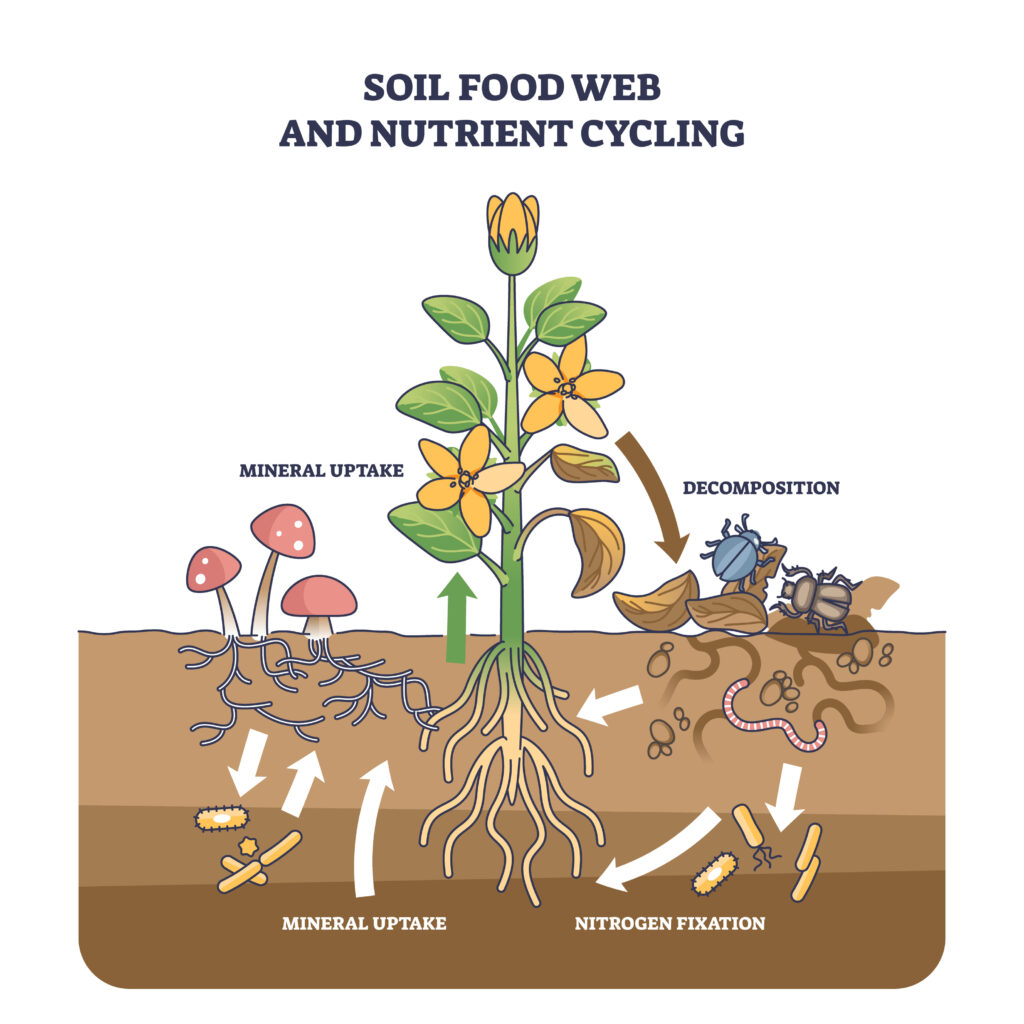
Most farmers focus on what they can see: the crop, the weather, and the yield. But some of the most important activity on any farm happens underground, where millions of tiny organisms are constantly working. Understanding the soil food web helps you make better decisions about how you manage your land.
And once you understand it, you start to see your soil completely differently.
The soil food web is the network of living things that exist in healthy soil. Bacteria, fungi, protozoa, nematodes, earthworms, and many other organisms all interact with each other and with plant roots in a constant cycle of feeding, dying, and decomposing.
Think of it like a food chain, but underground. Plants feed microbes. Microbes feed larger organisms. Those organisms die and release nutrients back into the soil. The cycle keeps going, and plants benefit from every stage of it.
Healthy soil is not just dirt with some nutrients in it. It is a living system. When the microbial biomass in your soil is strong, meaning the bacteria and fungi populations are active and balanced, several things happen naturally:
Bacteria and fungi are the foundation of the soil food web. They break down organic matter, release nutrients, and build the structure that holds soil together.
Bacteria tend to dominate in soils that get tilled frequently or treated with synthetic fertilisers. They cycle nutrients quickly but do not build long-term soil structure as effectively.
Fungi are slower but more powerful for long-term soil health. Fungal networks connect plant roots, transport nutrients over long distances, and help build the stable carbon structures that improve water retention. The fungal-to-bacterial ratio in your soil tells you a lot about where your soil health currently stands.
For agronomists working with multiple farms or fields, understanding the soil food web shifts the conversation from “what fertiliser do we apply” to “what does the biology in this soil actually need.”
That is a more useful question. It leads to decisions that improve long-term productivity rather than just patching short-term deficiencies.
The challenge has always been measurement. Soil microbial testing used to require lab equipment, long waiting times, and high cost. That made frequent testing impractical for most farms.
The soil food web is not a complicated concept once you break it down. Living soil feeds plants. Healthy microbes reduce the need for external inputs. And tracking soil biology over time gives farmers and agronomists the information they need to make genuinely better decisions.
The soil is already doing the work. Understanding it just helps you work with it instead of against it.
Farmers across America are discovering something amazing beneath their feet. The secret to better crops and healthier land isn’t always found in a bottle or bag. It lives naturally in the soil, waiting to be awakened through smart and intentional farming practices. Soil microbial communities play a large role in soil metabolic activity and drive critical ecosystem services like decomposition and nutrient cycling.
Bacteria, fungi, and other microscopic creatures transform dead plant material into food that crops can use. Regenerative agriculture & microbes work together like partners in a successful business. When farmers treat soil as a living system rather than just dirt, these microorganisms multiply and strengthen.
How Traditional Farming Hurts Soil Life
Conventional farming methods can accidentally damage the very organisms that make soil productive and alive. Heavy tilling breaks apart fungal networks that connect plant roots. Chemical fertilizers flood the system with quick nutrients but starve the microbes that naturally produce those same nutrients.
Soil health drops when microbial diversity and abundance decreases. Farms become dependent on more chemicals to achieve the same results. It’s like trying to run a factory with fewer workers each year while expecting the same output.
Different microbes handle different jobs in the soil. Some break down tough plant materials. Others protect crop roots from diseases. Many form partnerships with plants, trading nutrients for sugars. This complexity creates a stable system that keeps working even when conditions change.
Healthy microbial communities also help crops handle stress better. During droughts, diverse soil life improves water retention. When diseases threaten, beneficial microbes compete with harmful ones, protecting plant roots naturally.
Farmers don’t need complicated systems to start improving their soil life. Cover crops provide food for microbes when cash crops aren’t growing. These plants keep living roots in the ground, which helps more microbes stay fed year-round instead of going dormant.
Crop rotation brings diversity that supports more types of beneficial organisms. Different plants feed different microbes, and varying root depths access nutrients from multiple soil layers. This natural variety strengthens the entire system.
The benefits of regenerative farming show up quickly in soil tests and gradually in farm economics. Crops access nutrients more efficiently when healthy microbial populations cycle them naturally. This means farmers are able to spend less on fertilizers while maintaining or improving yields.
Weed and pest pressure often decreases, too. A diverse microbial community supports beneficial insects and creates conditions where crops outcompete weeds naturally. This reduces herbicide needs and the labor involved in weed management.
Fungal to bacterial ratio serves as an important indicator of soil condition. Healthy agricultural soils need both types of microbes, but many farms have shifted too far toward bacteria-dominated systems. Restoring fungal populations helps lock carbon in the soil and improves overall stability, as fungi connect different plants and transport nutrients across distances that roots alone could never reach.
The science behind soil biology keeps advancing, giving farmers better tools and understanding. New microbial products target specific crop needs or soil conditions. Education and support networks help farmers adopt these methods successfully. Universities, extension services, and farmer groups share practical knowledge gained from real-world experience. This collective learning accelerates the regenerative movement.