
Remember when you needed expensive equipment just to know what’s happening in your soil? Well now that same device you use to scroll social media and read the news can analyze soil health with lab-quality precision.
The Science Behind Your Pocket Soil Lab
Your smartphone possesses something laboratories have relied on for decades: sophisticated optical sensors and powerful processing capabilities. Modern smartphones can detect color variations, light intensity, and chemical reactions through their cameras and built-in sensors. When paired with the right testing reagents and apps, these everyday devices transform into legitimate soil analysis tools.
The principle is surprisingly straightforward. Soil samples react with specific chemical reagents, producing color changes that correspond to different nutrient levels, pH values, or biological activity. Your phone’s camera captures these color variations, while specialized algorithms interpret the data and provide instant results.
What Your Mobile Soil Lab Can Actually Measure
You might wonder what kind of soil data you can realistically expect from smartphone-based testing. The capabilities are more extensive than you’d think:
Real-Time Results That Actually Matter
The game-changer isn’t just the technology—it’s the speed. Traditional soil testing means collecting samples, shipping them to a lab, and waiting days or weeks for results. And by then, growing conditions and microbial communities may have changed completely. Smartphone-based soil lab technology delivers results in minutes, not days. This real-time capability transforms how you can manage your soil health. And the microBIOMETER® can help you do just that.
Notice your tomatoes looking yellow in mid-July? Test the soil immediately and adjust your fertilization strategy that same afternoon. Planning fall amendments for your lawn in Texas? Test multiple spots across your property in a single morning and create a targeted improvement plan.
Getting Started: Your First Mobile Soil Analysis
Setting up your smartphone as a soil lab is simpler than you might expect. The microBIOMETER® includes testing reagents, measuring tools, and a smartphone app that guide you through the entire process step by step. You’ll collect a representative soil sample, mix it with the provided reagents, and use your smartphone’s camera to capture the resulting color changes. The app then analyzes the images and provides detailed reports about your soil’s condition. The testing process is quick and you can see results in 20 minutes.
The Technology Revolution Happening Now
All-in-one smartphone-based devices are becoming preferable for agricultural soil analysis, enabling users to complete self-assessments about soil quality and receive performance reports with actionable insights.
The implications extend far beyond individual gardeners. Extension services at universities across the United States are incorporating smartphone soil testing into their educational programs. Community gardens in both rural and urban areas are using these tools to optimize their growing strategies and share soil health data among members.
 American BioChar Company is a Michigan-based company run by longtime green industry couple, Mark & Laurie Mann. For more than two decades, they have been researching and developing programs and products to improve soils, root conditions, and plant growth in urban, rural, and agricultural landscapes.
Over the last 3 years, they have conducted trials on blueberry farms in SW Michigan, using the microBIOMETER® and other soil-metric tests. The trials compared soils of blueberry bushes treated with their VITAL Blend soil amendment to those with untreated soil. Data was collected in the spring, summer and fall each year to demonstrate the natural ebb & flow of microbe communities in soils. Not only does the data show the steady increase of soil microbial biomass, but overall the trial sites have improved soil structure and more nutrient dense crops.
“The biggest impact we have in using the microBIOMETER® is demonstrating the successful transformation within the soil, following applications of our different biochar blended soil amendments. It provides confidence in our product and helps move the client conversation toward the biological benefits of our product. When a client is able to see and track the fungal to bacterial ratio for their soil overtime, it is very empowering.”
American BioChar is also undergoing several other trials throughout the mid-west with corn, cannabis, soybeans, and tree rhizospheres, using both their VITAL Blend and their new GRATEFUL Blend living soil. As both blends provide active and fixed carbon to soil, these trials were aimed to enhance and increase soil biology and restore nutrient density. Pre- and post- application photos can show how these products improved overall crop production.
Recently, Laurie Mann and microBIOMETER® president Laura Decker participated in Heart & Soil Magazine‘s Soil Summit discussing “How to Increase the Speed of Microbe Growth”. Click here to watch!

BioHub Solutions, an Australian company that provides biological solutions to the agricultural industry, has incorporated microBIOMETER® into their business. BioHub Solutions believes measurements should be simple whenever possible to ensure their implementation and repeatability. microBIOMETER® has become an integral part of the BioPlan processes. Growers also like it because it provides instant feedback and accountability for Biohub’s biological strategies.
“Our trees continue to do well against the control in areas such as average plant height growth, trunk to height ratio, and fungi to bacteria ratio utilizing microBIOMETER®. This is pleasing so far and we will continue measurements.”

Green bean study in North Queensland.
Green bean trial in North Queensland (above). Initial samples taken 2 weeks before harvest. So far overall bean numbers are 36% improved over control. More importantly, marketable sized numbers are improved by 52%. This is where the margin is for the grower. Microbial biomass is also 28% higher than control which is pleasing. Looking forward to the full harvest figures if they reflect the initial samples taken.
Olive rootstock (below). The data has indicated on average, a 17% increase in stem diameter over the control. Root weight improvements of 47%, biology biomass improvements of 46% and fungal to bacterial ratio improvements of 56% over control. This illustrated that the BioHub solution achieved results in the manner the team had predicted. Photo depicts an example of the treated plug on the left and control on the right.

Olive rootstock – treated

Olive rootstock – control
 Francis Lawton an 8th grader at St. Timothy School in Los Angeles, CA utilized microBIOMETER® in his science fair project titled “The Effect of Greywater on Plant Growth, Soil Microbial Biomass Carbon, and Soil Fungi to Bacteria Ratio. Francis took first prize at the fair and moved on to the Los Angeles County Science & Engineering Fair where he placed 3rd in his category of Ecology. He also received a special award from USAID (U.S. Agency for International Development). Francis then took part in the California State Science & Engineering Fair in the category of Earth & Environment (Air/Water) and placed 2nd!
Have a science fair project coming up and would like to incorporate microBIOMETER®? Please contact us!
Project Abstract:
This project was designed to find out if greywater and treated greywater can safely hydrate plants, and promote plant growth, just as well as tap water. I live in drought-prone California and it’s important to find different ways of conserving water. My experiment tested the watering of grass pots with three different types of water (independent variable): Tap water, Greywater, and Greywater treated with Activated Charcoal. Over the course of 8 weeks, I measured plant growth, soil Microbial Biomass Carbon (MBC) levels and soil Fungi to Bacteria (F:B) ratio (dependent variables). Many controlled variables ensured a valid experiment. I hypothesized that each of the water types would result in the same growth rate, soil MBC and soil F:B ratio. My hypothesis, however, was incorrect. Greywater resulted in stunted growth and spiked the F:B soil ratio so high that the pot sprouted 13 fungi heads. Tap water and Treated Greywater, however, were equally good in terms of healthy plant growth and both pots had the two best average F:B ratios closest to 1:1 (which is the best ratio for grasses). Neither of these pots produced fungi. Soil carbon levels (MBC) fluctuated for all three plants, however each plant maintained an “Excellent” level. This indicated that each water type was fine for watering grass if you don’t mind stunted grass growth and some fungi in your lawn. My experiment also proved that Activated Charcoal effectively “adsorbs” chemicals in greywater that alter a soil’s F:B ratio.
Created and performed by microBIOMETER® intern, Leanna Ramus, environmental science student at Siena College, this sample experiment is appropriate for high school and advanced middle schoolers.
The research project is designed to help students study soil health and understand the impact of soil biology on soil health and plant growth. Supplies are minimal cost and nothing recommended is dangerous or controlled. We expect students to use this as a guide to develop their own experiment.
We love supporting young minds with a passion for soil science. They are the future of soil health! If you are an educator that would like to bring microBIOMETER® soil testing into the classroom, we have three Academia Kits available for purchase. We are also happy to cater supplies to your specific needs. Please contact us for more information!

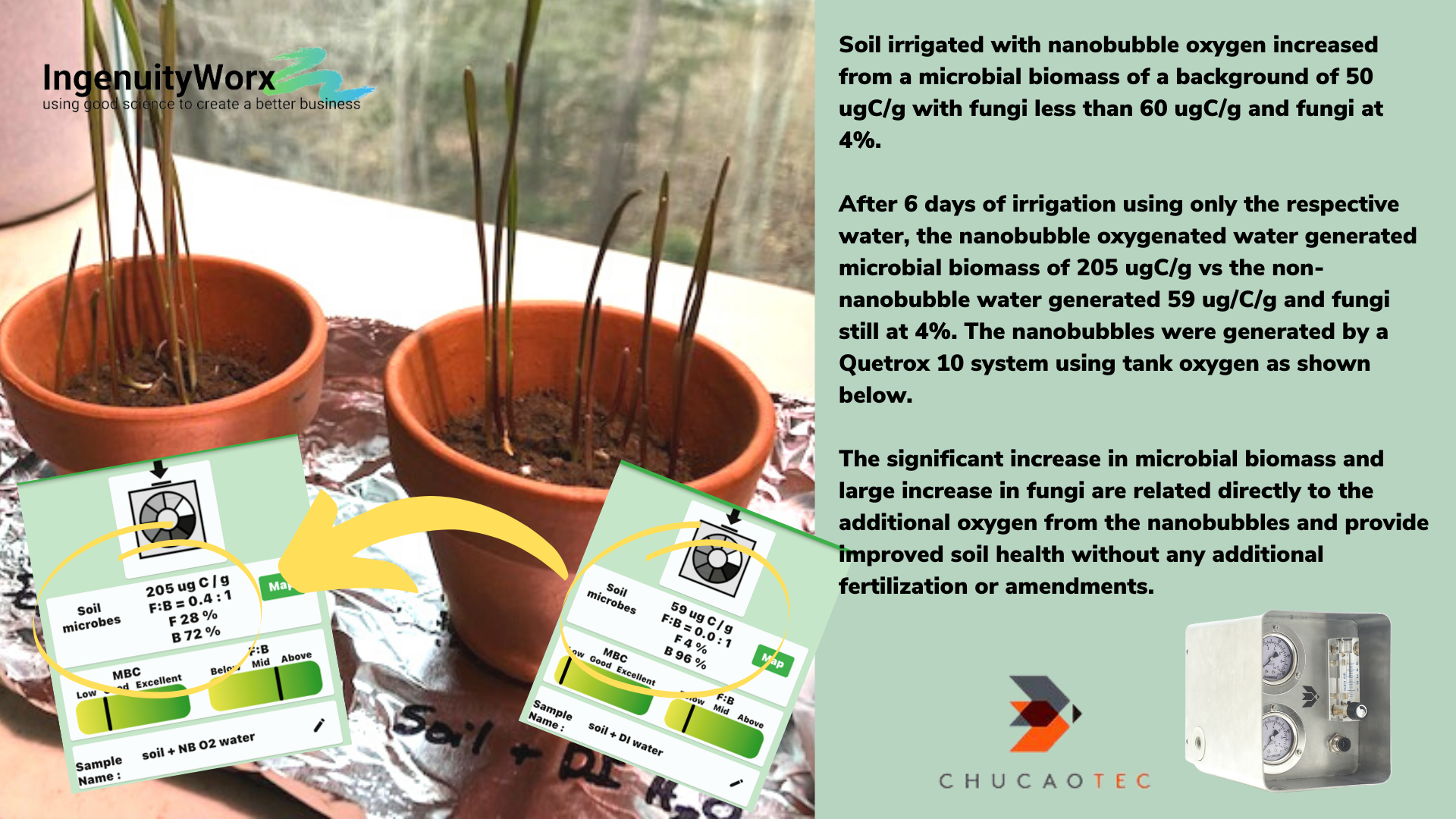
IngenuityWorx has been working to prove that the application of nanobubble oxygen as an irrigation/fertigation tool can provide low cost, easily applied plant benefits both indoors and outdoors.
It has been known for over 40 years that increased oxygen to plant roots in soil improves nutrient absorption, reduces effects of saline water or sodic soils, and increases plant growth and yields. However, traditional aeration technology prevented its use. Aerated water was limited to very short application duration and limited travel time in an irrigation line with low oxygen transfer efficiency.
The new science of nanobubbles allows us to add high dissolved oxygen concentrations, reaching 30-50 ppm, and the oxygen transfer will continue to take place for weeks. The nanobubbles don’t coalesce and break like macro bubbles, they move within the water using Brownian motion, and upon giving up all their oxygen produce small amounts of reactive oxygen species including hydrogen peroxide. This feature provides a built-in cleaning process that removes biofilm.
The microBIOMETER® analysis here shows that high dissolved oxygen in the irrigation water stimulated the microbial biomass and fungi to increase in number indicating a healthy microbiome in the soil for plant growth.
Additional work is ongoing to measure and understand the effects of the oxygenated water and microbial increases as it relates to soil carbon utilization, and its impact on carbon reserves and available nutrients. For more information, please contact bo*@***********rx.com.
 Arbuscular mycorrhizal fungi (AMF) penetrate the root and establish little areas in plant root cells where they can exchange nutrients with the plant. AMF improves the nutrients available to the plant by collecting soil minerals such as phosphorous, nitrogen, magnesium and manganese through an extensive network of fine fibers (hyphae) that increase the absorptive area of the root up to a hundred-fold. In return the plant feeds the fungi carbohydrates and lipids. AMF secrete hormone like substances that stimulate plant growth and AMF encourages the establishment of nitrogen fixing bacteria. The AMF boost to plant growth comes not only from the nutrients it supplies. AMF also improves the immune response of plants making them resistant to harmful nematodes and insects as well as fungal and bacterial pathogens.
AMF shows great promise in compensating for yield losses when chemical fertilizers are eliminated or greatly reduced. AMF can reduce the need for pesticides and phosphate and nitrogen fertilizers cutting back on input costs all while building healthier soil.
In light of the known importance AMF plays in your plant’s health, microBIOMETER® now provides the fungal to bacterial ratio of your soil. This information will further assist you on your road to healthy soil while helping you lower your costs.
Leifheit, E. F., Veresoglou, S. D., Lehmann, A., Morris, E. K., & Rillig, M. C. (2014). Multiple factors influence the role of arbuscular mycorrhizal fungi in soil aggregation—a meta-analysis. Plant and Soil, 374(1-2), 523-537.
 Arbuscular Mycorrhizal Fungi (AMF) colonize 80% of crops. Their effect on plant growth can be positive, neutral or negative. It depends on many factors including the crop species and genotype, the species of AMF, and the characteristics of the soil. A low pH favors colonization of the plant by AMF while application of chemical fertilizers, especially phosphate, inhibits colonization by AMF. In the absence of chemical fertilizers and in the presence of low levels of pH, AMF provides the plant with phosphorous. AMF can extract P from rocks so it can get P from soil that tests low for P.
AMF can dramatically increase plant yield and resistance to pathogens and drought, as well as decrease irrigation needs and sensitivity to salinity. Thus, AMF can be of great assistance in transitioning from conventional to sustainable/regenerative agricultural. There are now many suppliers of AMF but there is no guarantee that any one product will be optimal for your crop and your soil.
The new microBIOMETER® test, which estimates fungal to bacterial ratios in soil, can help you decide which AMF works best with your plant and soil because it can detect colonization of rhizosphere soil for fungi within a month of AMF application.
Leifheit, E. F., Veresoglou, S. D., Lehmann, A., Morris, E. K., & Rillig, M. C. (2014). Multiple factors influence the role of arbuscular mycorrhizal fungi in soil aggregation—a meta-analysis. Plant and Soil, 374(1-2), 523-537.