
Imagine this: The earthy scent of microbes breaking down leaves in the soil fills the air. Your harvest is complete, the season is winding down, and you’re likely looking forward to a well‑deserved break. But before you prepare for winter, seize the opportunity to assess the health of the microbes in your soil. It will pay off next spring! Testing microbial biomass carbon (MBC) and fungal-to-bacterial (F: B) ratios during autumn sets the stage for healthier, more resilient soils next spring. This proactive step is in your hands, and it’s a crucial one.
Here’s why autumn is the sweet spot for measuring soil biology:
1. Post-harvest tests show the real impact of your management
Sampling during autumn captures the “end-of-season report card” for your soil. It reflects how crops and cover crop management shaped microbial life through the growing season. Studies by Cornell University show post-harvest data shows differences between treatments, with diverse cover rotations supporting higher microbial activity compared to standard fallow fields. In other words, autumn tests provide a clear picture of how your decisions paid off biologically.
2. Results guide action plans for the winter
Nebraska Extension notes that low MBC signals low biological activity and carbon availability—exactly the type of challenge that can be addressed when you act ahead of spring. Autumn is your window to respond before soils go quiet in winter. If MBC trends low, you can jumpstart recovery with practices like:
3. Amendments need time to work
If you know your soil is acidic and requires lime, autumn or manure additions, autumn is the best time to make applications and alterations to the microbial ecosystem. Amending now gives the soil several quiet winter months to equilibrate, ensuring pH is in the right range for nutrient availability and microbial activity by the time you plant again.
4. Fall testing builds valuable trend data year over year
Soil health is about direction, not just snapshots. Measuring MBC and F: B ratios every autumn lets you to track whether regenerative practices are truly building biology year after year. That trendline is powerful for farmers, researchers, and anyone looking to prove results.
Final Takeaway: Think of fall microbial testing during autumn as giving your soil a health check before it goes to sleep. You’ll capture a clear understanding of how the season’s management impacts microbes and receive the insights you need to act. When spring rolls around, and microbial life ramps up, you’ll be ready with soils that are biologically prepared for partnering with plants in helping them grow.
 We first had the pleasure of working with Briana Alfaro and Soul Fire Farm in 2021 when they began testing soil with farmers in their network as part of their SARE research project, Soil Carbon Capture for Diverse Farmers; Black, Latinx, Asian, Indigenous and other farmers and farm workers of color take the lead in testing soil carbon sequestration strategies and measurement protocols and disseminate those findings to the farming community in both English and Spanish.
Every two years the Soul Fire Farm team takes a closer look at the soil ecosystem and assesses how healthy their soil is. They do this by performing a series of in-field tests. Long before the western study of soil science, Indigenous communities practiced–and still practice–methods of evaluating soil health using characteristics such as color or the presence of specific plants or insects that tell us something about the system as a whole. On their soil testing days, they count the number of earthworms, perform a slake test to observe aggregate stability, look at soil color as an indicator of organic matter, and use the microBIOMETER® field kit to assess soil biology.
You can learn more in their Guide to In-Field Soil Health Measurement Protocols: How Alive is My Soil (English) & ¿Qué tan vivo está mi suelo? (Español), and by watching their Liberation on Land skill share videos: Soil Carbon part 1, Soil Carbon part 2 & Investigating Soil with an Auger.

[IMAGE: https://images.unsplash.com/photo-1615053835734-7752878e939e] Credit: Unsplash
Regulatory initiatives have developed carbon trading prospects to combat carbon emissions, providing specific industries with an “allowance” for each tonne of carbon dioxide they emit annually, known as carbon credits. This initial allocation of carbon credits can be free of charge, and businesses are presented with more opportunities to buy or sell carbon credits. Companies with reduced carbon emissions can sell their excess carbon credits to participants who have increased emissions— forming the carbon market.
A feature on global issues by Maryville University notes that emissions of greenhouse gases must be halved by 2030 to avoid a climate catastrophe. However, global economies representing 90% of all such emissions have yet to commit to cutting carbon outputs at sufficient rates to meet this goal. Through the formation of the carbon market, businesses and organizations may be more incentivized to cut down on carbon emissions through the use of carbon offsets. These voluntary schemes come from groups that already have active carbon reduction plans, aiding buyers to work toward carbon neutrality by reducing emissions elsewhere.
As more governments, businesses, and organizations join the carbon market, individuals and smaller organizations can find it difficult to purchase emission-reducing carbon credits. Furthermore, the voluntary carbon market often lacks transparency and quality control, so there is a greater need for more accountability to open up new markets. As shared in a review on blockchain solutions by One Earth, blockchain technology has become a means to improve the integrity and accessibility of carbon markets. Because it’s a publicly available record and a third-party intermediary is absent, it can avoid ambiguity over ownership and double counting emissions reductions while reducing administrative costs across the system.
These unique processes can streamline and accelerate the carbon market digitally, allowing organizations and individuals to meet their carbon footprint reduction goals much sooner. Furthermore, the global economy may become more efficient and effective in supporting climate action as funding is distributed more transparently.
Many are aware that agriculture, especially animal agriculture, greatly contributes to carbon emissions. However, the development of soil carbon capture systems and farming practices such as regenerative agriculture has significantly reduced agricultural emissions, even lowering existing carbon emission levels through soil carbon sequestration. Our post “How microBIOMETER® Changed the Farming Practice of a Syntropic Farmer” shares how regenerative agriculture is kept up sustainably: soil maintenance is regularly monitored through soil microbial count and the use of natural soil supplements, promoting soil development to capture carbon effectively. These methods prevent soil desertification and provide a great opportunity for farmers to turn climate-friendly agricultural practices into carbon credits.
Companies like NORI establish carbon markets in support of regenerative agricultural practices that perform as carbon removal solutions. A third-party validator measures land management practices and crop data to assess the impact of a farmer’s regenerative practices, providing credibility and transparency to how much carbon can be removed per contribution. Through the reliability of the blockchain system, the carbon market is sure to flourish, granting more people the freedom to make a positive environmental impact.
Written by Sophia Logan for microbiometer.com
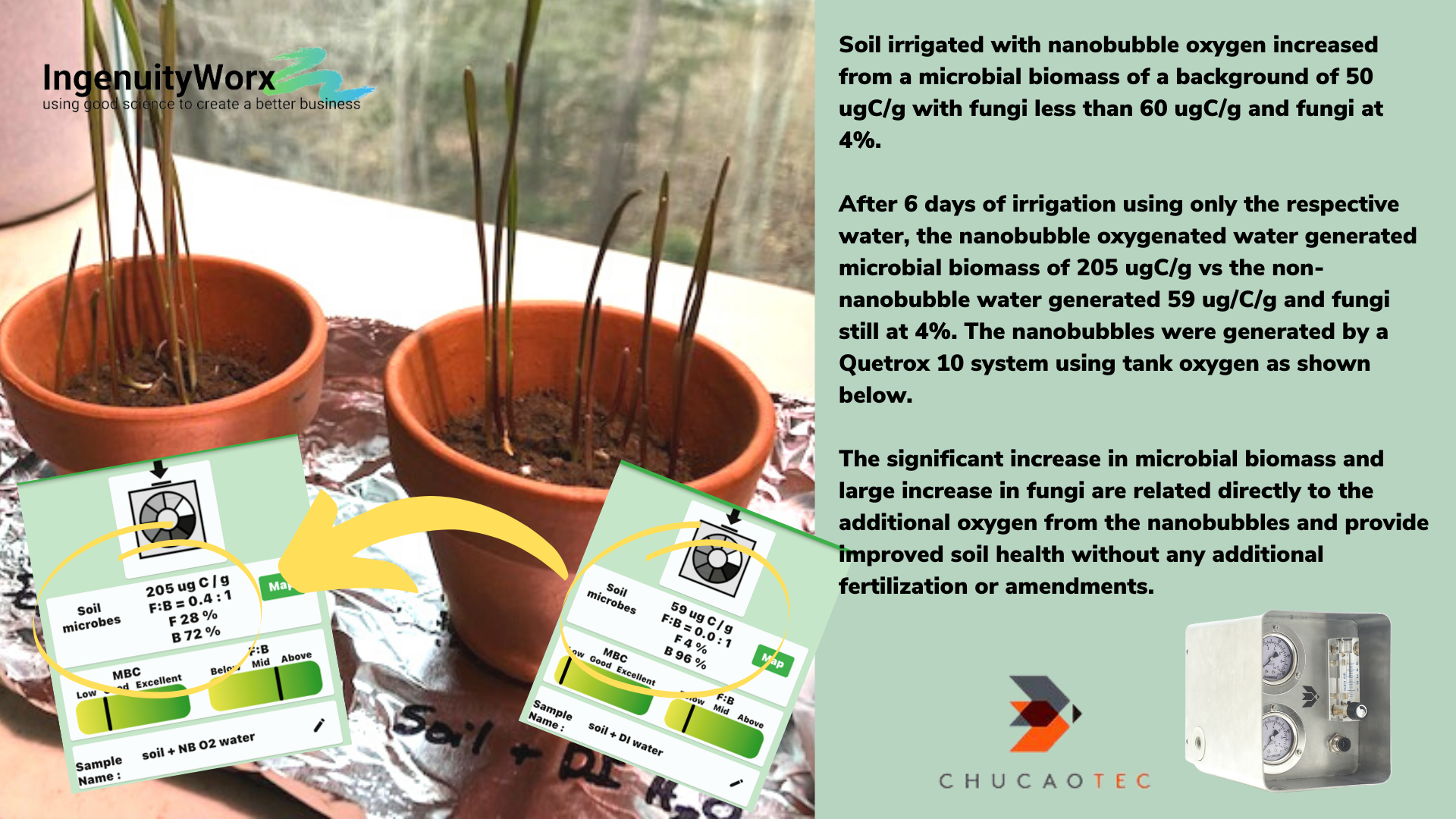
IngenuityWorx has been working to prove that the application of nanobubble oxygen as an irrigation/fertigation tool can provide low cost, easily applied plant benefits both indoors and outdoors.
It has been known for over 40 years that increased oxygen to plant roots in soil improves nutrient absorption, reduces effects of saline water or sodic soils, and increases plant growth and yields. However, traditional aeration technology prevented its use. Aerated water was limited to very short application duration and limited travel time in an irrigation line with low oxygen transfer efficiency.
The new science of nanobubbles allows us to add high dissolved oxygen concentrations, reaching 30-50 ppm, and the oxygen transfer will continue to take place for weeks. The nanobubbles don’t coalesce and break like macro bubbles, they move within the water using Brownian motion, and upon giving up all their oxygen produce small amounts of reactive oxygen species including hydrogen peroxide. This feature provides a built-in cleaning process that removes biofilm.
The microBIOMETER® analysis here shows that high dissolved oxygen in the irrigation water stimulated the microbial biomass and fungi to increase in number indicating a healthy microbiome in the soil for plant growth.
Additional work is ongoing to measure and understand the effects of the oxygenated water and microbial increases as it relates to soil carbon utilization, and its impact on carbon reserves and available nutrients. For more information, please contact bo*@***********rx.com.

Austin Arrington of the Plant Group
Austin Arrington of Plant Group NYC performed a research study on hemp’s capacity to sequester carbon. Austin utilized microBIOMETER® in this research. We originally had the pleasure of meeting Austin through Indigo Ag’s Terraton Challenge. Plant Group is a fellow semi-finalist and alumni.
Hemp has the promise of being a twofer: a financially successful crop as well as a carbon crop that increases soil carbon for carbon credits and increased fertility. Austin used microBIOMETER® to evaluate two organic fertilizer regimens for a hemp crop; an early fertilization during the vegetative phase and a month later during the flowering phase.
Honeysuckle Hemp 2021: Research Notes
One hectare of industrial hemp can absorb up to 22 tonnes of CO2 per hectare. The fact that industrial hemp has been proven to absorb more CO2 per hectare than any forest or commercial crop makes it an ideal tool for carbon farming (Vosper, 2011).
Two acres were hand seeded with Maya hemp grain on 05/23/21 in a silt clay loam soil in Council Bluffs, IA. Prior to tilling (with a rear tine tiller) and seeding with hemp the area was covered with white clover. The area was split into two zones that each received organic fertilizer at different times. The Early Fertilizer Zone was fertilized on 07/25/21. The Late Fertilizer Zone was fertilized on 08/08/21. Mega Green (2-3-2), the organic fertilizer applied for the study is derived from squid waste and was diluted with water for application across the field.
The microBIOMETER® spectroscopic tool was used to estimate microbial biomass carbon and fungal to bacterial ratio. Microbial biomass carbon is a measure of the carbon ( C ) contained within the living component of soil organic matter (i.e. bacteria and fungi). Microbes decompose soil organic matter (SOM) releasing carbon dioxide and plant available nutrients. The measurement unit of the device is ug C / g (micrograms microbial biomass carbon). Click here to read full study.
 Calibration of microBIOMETER® to units of µg microbial carbon / gram soil
The gold standard of laboratory soil microbial biomass testing is Chloroform Fumigation and Extraction (CFE). The multiple steps, time, and labor involved with CFE require pricing at up to $500 per sample. CFE works by comparing the difference of chemically extractable carbon between two portions of a soil sample: One that has been treated to break open microbial cell membranes and expose the carbon-containing biological molecules to extraction, and one that has not. The difference in carbon for the two portions is reported as microbial biomass carbon (MBC), in units of µg C / g soil.
microBIOMETER® is calibrated to the same units by a different method. Estimates of bacterial dry mass converge at around one trillionth (1×10-12) of a gram (1 pg) for a 1 µm bacterium. We measured the area of microbes in known volumes of microBIOMETER® extract (both by manual counting on a hemocytometer and by digital analysis of micrographs) and calculated total microbial mass, which was then converted to µg / g for the whole 0.5 ml sample of soil in the extract. We found that on average, 0.5 ml of soil weighs 0.6 g when fully dried, independent of starting moisture content. The 1 pg dry mass per bacterium is 50% carbon, so we also had to account for that in our calibration.
Here’s an example of the conversion.
Let’s say that in 1×10⁻⁸ liter (10 nl) of microBIOMETER® extract we measured 240 µm2 of microbes. 240 µm2 = 240 bacteria equivalents (BE). 240 BE x 1×10-12 g per BE = 240×10-12 g of dry microbes. The volume of original extract is 10 ml (1 x 10⁻² liter), and 10 nl of microscopically examined extract represents 1×10⁻⁸/1×10-2 = 1×10⁻⁶ of the total mass of the microbes in the extract. So 240×10-12 g microbes / 1×10-6 = 240 x 10-6 g microbes in the whole extract. 50% of the 240 x 10-6 g of microbes is carbon, so we have 120 x 10-6 g microbial carbon. We started with 0.5 ml = 0.6 grams of dried soil in the extraction process, therefore 120 x 10-6 g microbial carbon / 0.6 g soil = 200 x 10-6 g microbial carbon / gram soil, or 200 µg microbial carbon / gram soil.
While we arrived at µg microbial carbon / gram soil through a different method than CFE, it turns out our methods are on par with the CFE test. We compared measurements of µg carbon / gram soil via CFE and microBIOMETER® from 28 soils from across the U.S.
The slope of ~1 of the regression line indicates our units are on par with CFE, and the 94% correlation indicates that users can be confident that the $13.50 or less microBIOMETER® test gives results as accurate and informative as one priced $500.

We recently received the following questions from one of our customers and below are the responses from Dr. Fitzpatrick.
Part of my research is surrounding the soil organic carbon results we attained from microBIOMETER®, and I am wondering if someone from your team could provide more information on what this means relative to total organic carbon (TOC) in a sample and if they are comparable?
The literature shows a strong correlation between available organic carbon and microbial biomass carbon (MBC). Since your compost is not soil, the available organic carbon in your sample would be TOC and would correlate. MBC by microBIOMETER® is even better than that: a big number tells you that you have carbon and all the nutrients needed by microbes and plants.
Since MBC has correlations to TOC is there a formula or percentage to convert MBC to TOC? Or approximately how much MBC makes up a TOC number?
There is no formula to correlate TOC with MBC. TOC includes carbon that we consider stored as well as carbon that is easily available to microbes. Increasing easily available carbon for example by applying compost will increase microbes and eventually increase TOC, but as microbes rarely exceed 1% of TOC, it would have little effect on TOC short term. In long term stable systems we see a correlation but the correlation is not the same for example in forest as in agriculture as the capacity to store TOC is different soils under different conditions. In studying the effect of long term (40 years) different management systems at U. of TN on MBC and TOC, MBC by microBIOMETER® correlated with the TOC demonstrating the effectiveness of sustainable practice on increasing TOC and the positive correlation with MBC levels.
Does a high MBC usually mean a higher F:B ratio? And if so, could we draw any conclusions about carbon sequestration capabilities from that?
Generally as the MBC increases there is an increase in fungi. The soil food web is a balanced community. Some communities are more fungal dominated some less, but similar communities tend to have the same F:B ratio. It is generally believed that fungi, especially mycorrhizal fungi, contribute more to carbon sequestration than bacteria. This may be because glomalin is carbon rich and tends to sequester.
To further my understanding of soil/compost mixtures. I performed two microBIOMETER® tests. One test was on “active compost” which is compost in a medium stage of decomposition, and generates some CO2 and another one “finished compost” which is cured, ready for usage, and low CO2 production. However, I found that they had similar amounts of MBC and F:B ratio. Is this normal?
A study with microBIOMETER® at University showed a higher F:B in finished compost. The higher respiration/MBC indicates that your unfinished compost is still being digested — working microbes make more CO2. Holding MBC stable in your finished product is good.

Chiappetta Agricultural Company
We were excited to hear from our long-time customer Marcelo Chiappetta of Chiappetta Agricultural Company on how his microBIOMETER® testing has been progressing. Below is what he shared with us.
“Here in southern Brazil the past 5 years we’ve been working with biological agriculture and changing the way we see and manage our farm; more and more like an agricultural organism. Taking care of microorganisms, plants, animals and humans and focusing on producing high quality grains.
Fungal and bacterial ratio is fundamental to know how our soil is related to what crop we grow. And now, after starting to brew compost tea and using compost extract, microBIOMETER® is helping us measure and understand the right recipe of carbon and nitrogen related to the amount of fungi that we want to build in our composts before adding to the soil. We see that good microbial biomass along with organic matter is excellent for our soils.
In practical terms, we see biological flowering in crop fields and this is the proof that we are doing a great job with nature. Our soil is our bioreactor, and we need to feed it with the right nutrients. The Brazilian biome is rich on biodiversity and as farmers and soil guardians we have a responsibility to bring life back to our farm again in a sustainable way of producing food.”
Click here to read more on Marcelo’s soil testing.

Soil testing
Modern agriculture practices have led to the systematic degradation of the world’s soil and release of carbon into the environment. The effects are increased need for expensive and environmentally dangerous inputs (fertilizers, pesticides, and herbicides), the loss of fertile top soil, decrease in water holding capacity of soil and dangerously high levels of atmospheric carbon.
Farmers, industry, and environmentalists are looking for cost-effective and reliable ways to measure soil health, to assess impacts of progressive changes on soil and harvest management, and to measure carbon in soil. Before microBIOMETER®, growers have traditionally relied on expensive lab testing of soil. Many current methods are technique and individual lab dependent. Therefore, run-to-run and lab-to-lab variation can greatly affect consistency leading to increased variability. Current methods are performed in labs and the soil is aged and changed from the time of collection. Furthermore, lab tests are difficult to use in developing countries as they can cost upwards of $500 per sample. This makes the test prohibitive to some markets and limits the number of times a grower can test their soil.
Our mission at Prolific Earth Sciences is to enable soil stewards all over the world to use mobile technology and our low-cost soil test to assess regenerative soil practices, to improve soil health, and work towards increased soil carbon sequestration. microBIOMETER® equips growers with the data necessary to make decisions on which practices are the most cost-effective. Inputs such as fertilizers are expensive and changes to practice are risky. Monitoring soil microbial biomass inexpensively, in real time, can help a soil steward quickly assess if an input and practice is improving soil health and worth the investment. In other words, assess before you invest! We also envision microBIOMETER® one day being a powerful tool in the measurement and audit of carbon sequestration programs.
microBIOMETER® has been on the market for over 3 years with direct and distributor sales and currently has customers in over 20 countries.

Soil carbon is important to soil health because it enables microbial life. Microbes are able to obtain carbon directly from plant exudates, however, much of their carbon source is from the dead plant and plant derived materials that they digest. We harvest much of the above ground matter from crops, but plant roots, cover crops and various manures can provide additional sources of carbon and other nutrients for microbes. Pure carbon, for instance coal, is not something we add to soil to increase fertility. It is the soil organic carbon, the carbon originally derived from the living plant, animal and microbial sources, that predicts soil health. This is because it is food for microbes. Without fungi and bacteria making the glues that allow microbes to stick to soil and create soil texture, the soil becomes a powder that is easily eroded and does not hold water. Moreover, without microbes that are so tightly bound to the soil to store nutrients, the soil becomes barren.
Soil carbon begins as plant exudates and dead plant material and ends as humus, the molecular remnants of the bodies and refuse of dead animals and microbes that digested the plant material. Newly broken-down plant material is close to the surface and available to microbes as soluble organic carbon. Using this easily accessible carbon, microbes can multiply. Furthermore, carbon that is in microbes and other inhabitants of the soil food web can be viewed as a savings account. Turnover in the food web is rapid and these materials are being recycled. As organic carbon molecules become in excess, i.e., they are not rapidly recycling, they attach themselves tightly to minerals and clay. In this state they are more difficult for microbes to access. They begin to descend deeper into the soil becoming even more closely associated with soil particulate matter and can now be described as sequestered carbon. The amount of carbon your soil can potentially sequester depends heavily on the particulate matter of your soil. Some soils can accumulate as much as 20% others probably less than 3%.
Earth has surrendered 50% of its sequestered carbon to the atmosphere. How did this happen? As a plant starts to grow, it sends out exudates that stimulate the dormant microbes to start multiplying and working to bring nutrients to the plant. If there is insufficient soluble organic carbon available, the plant stimulated microbes will need to mine carbon from stored carbon sources. Over many years of non-regenerative farming, the microbes have depleted this stored carbon. Mineral fertilizers have replaced the microbes bringing minerals to the plants, but they do not provide carbon for microbial growth. Moreover, plants do not put out exudates for microbes when supplied with mineral nutrients – the stimulus for exudates is the need for minerals. The tragic outcome of low microbes is the loss of soil texture which leads to soil erosion and the inability of the soil to retain moisture.
You need to have all forms of carbon for soil health; plant exudates to stimulate microbial growth, newly digested matter, soluble organic carbon for the population explosion, and stored carbon for the poor times when the microbes need to delve into their reserves. You also need to store carbon by feeding the microbes carbon and replacing minerals in a manner that does not inhibit microbial growth. Sequestered carbon is 60-80% the remains of dead microbes.