
Most farmers focus on what they can see: the crop, the weather, and the yield. But some of the most important activity on any farm happens underground, where millions of tiny organisms are constantly working. Understanding the soil food web helps you make better decisions about how you manage your land.
And once you understand it, you start to see your soil completely differently.
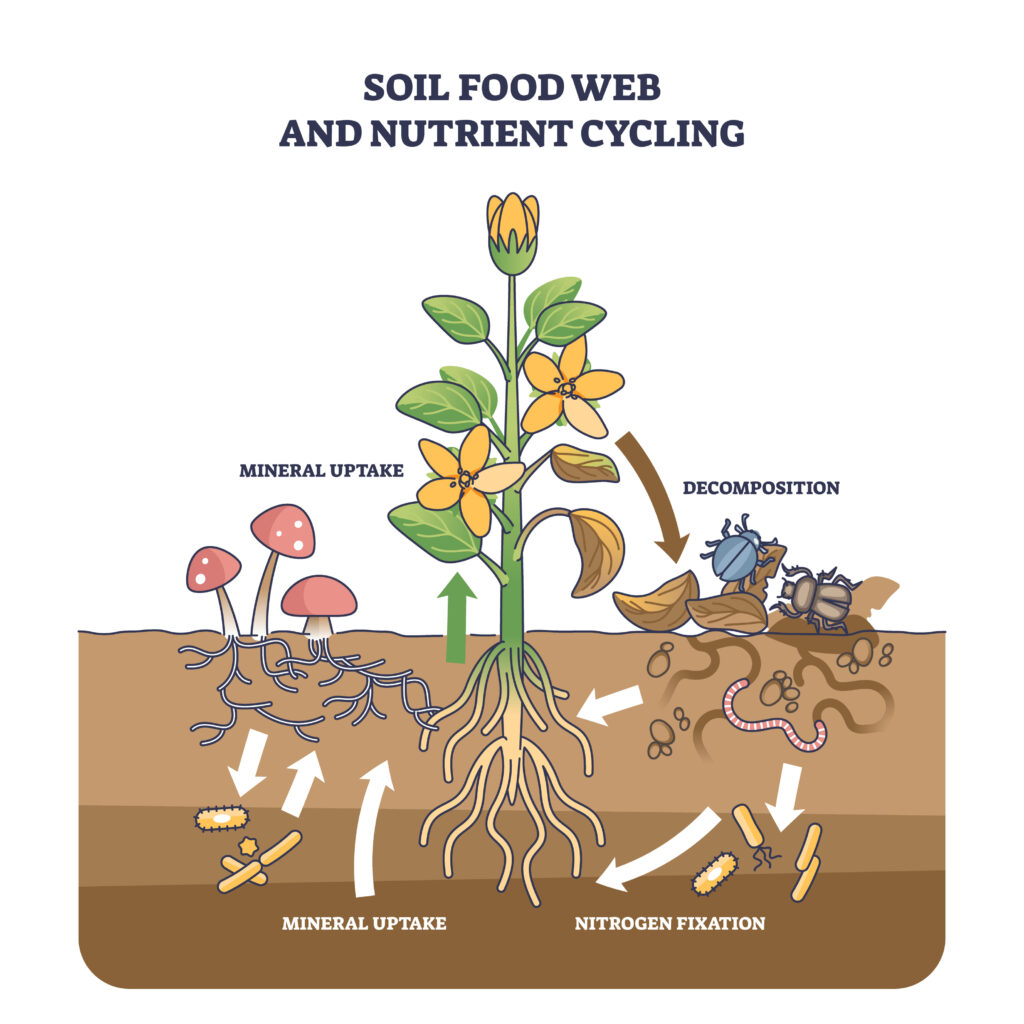
The soil food web is the network of living things that exist in healthy soil. Bacteria, fungi, protozoa, nematodes, earthworms, and many other organisms all interact with each other and with plant roots in a constant cycle of feeding, dying, and decomposing.
Think of it like a food chain, but underground. Plants feed microbes. Microbes feed larger organisms. Those organisms die and release nutrients back into the soil. The cycle keeps going, and plants benefit from every stage of it.
Healthy soil is not just dirt with some nutrients in it. It is a living system. When the microbial biomass in your soil is strong, meaning the bacteria and fungi populations are active and balanced, several things happen naturally:
Bacteria and fungi are the foundation of the soil food web. They break down organic matter, release nutrients, and build the structure that holds soil together.
Bacteria tend to dominate in soils that get tilled frequently or treated with synthetic fertilisers. They cycle nutrients quickly but do not build long-term soil structure as effectively.
Fungi are slower but more powerful for long-term soil health. Fungal networks connect plant roots, transport nutrients over long distances, and help build the stable carbon structures that improve water retention. The fungal-to-bacterial ratio in your soil tells you a lot about where your soil health currently stands.
For agronomists working with multiple farms or fields, understanding the soil food web shifts the conversation from “what fertiliser do we apply” to “what does the biology in this soil actually need.”
That is a more useful question. It leads to decisions that improve long-term productivity rather than just patching short-term deficiencies.
The challenge has always been measurement. Soil microbial testing used to require lab equipment, long waiting times, and high cost. That made frequent testing impractical for most farms.
The soil food web is not a complicated concept once you break it down. Living soil feeds plants. Healthy microbes reduce the need for external inputs. And tracking soil biology over time gives farmers and agronomists the information they need to make genuinely better decisions.
The soil is already doing the work. Understanding it just helps you work with it instead of against it.

Soil carbon is important to soil health because it enables microbial life. Microbes are able to obtain carbon directly from plant exudates, however, much of their carbon source is from the dead plant and plant derived materials that they digest. We harvest much of the above ground matter from crops, but plant roots, cover crops and various manures can provide additional sources of carbon and other nutrients for microbes. Pure carbon, for instance coal, is not something we add to soil to increase fertility. It is the soil organic carbon, the carbon originally derived from the living plant, animal and microbial sources, that predicts soil health. This is because it is food for microbes. Without fungi and bacteria making the glues that allow microbes to stick to soil and create soil texture, the soil becomes a powder that is easily eroded and does not hold water. Moreover, without microbes that are so tightly bound to the soil to store nutrients, the soil becomes barren.
Soil carbon begins as plant exudates and dead plant material and ends as humus, the molecular remnants of the bodies and refuse of dead animals and microbes that digested the plant material. Newly broken-down plant material is close to the surface and available to microbes as soluble organic carbon. Using this easily accessible carbon, microbes can multiply. Furthermore, carbon that is in microbes and other inhabitants of the soil food web can be viewed as a savings account. Turnover in the food web is rapid and these materials are being recycled. As organic carbon molecules become in excess, i.e., they are not rapidly recycling, they attach themselves tightly to minerals and clay. In this state they are more difficult for microbes to access. They begin to descend deeper into the soil becoming even more closely associated with soil particulate matter and can now be described as sequestered carbon. The amount of carbon your soil can potentially sequester depends heavily on the particulate matter of your soil. Some soils can accumulate as much as 20% others probably less than 3%.
Earth has surrendered 50% of its sequestered carbon to the atmosphere. How did this happen? As a plant starts to grow, it sends out exudates that stimulate the dormant microbes to start multiplying and working to bring nutrients to the plant. If there is insufficient soluble organic carbon available, the plant stimulated microbes will need to mine carbon from stored carbon sources. Over many years of non-regenerative farming, the microbes have depleted this stored carbon. Mineral fertilizers have replaced the microbes bringing minerals to the plants, but they do not provide carbon for microbial growth. Moreover, plants do not put out exudates for microbes when supplied with mineral nutrients – the stimulus for exudates is the need for minerals. The tragic outcome of low microbes is the loss of soil texture which leads to soil erosion and the inability of the soil to retain moisture.
You need to have all forms of carbon for soil health; plant exudates to stimulate microbial growth, newly digested matter, soluble organic carbon for the population explosion, and stored carbon for the poor times when the microbes need to delve into their reserves. You also need to store carbon by feeding the microbes carbon and replacing minerals in a manner that does not inhibit microbial growth. Sequestered carbon is 60-80% the remains of dead microbes.