
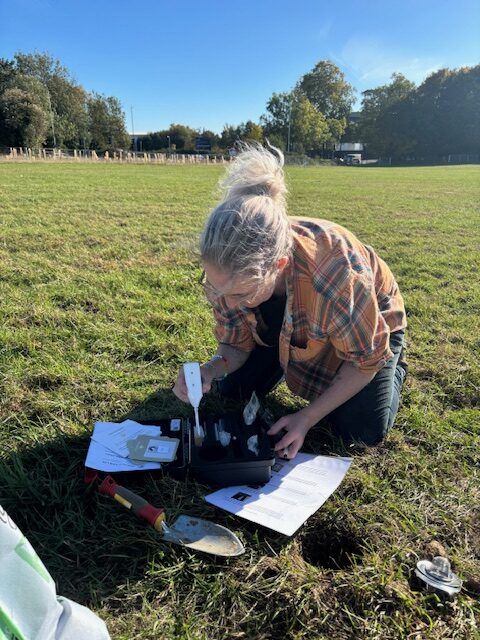
Recently, the Soil Association team was at Woodoaks Farm in Hertfordshire, England collecting soil samples as part of the AI 4 Soil Health project (AI4SH). Madeleine Silberberg, Project Coordinator, coordinates 13 pilot sites across the continent in partnership with leading European institutions. These sites, covering 11 pedoclimatic regions, were selected based on distinctive soil qualities. The team are using advanced measurement techniques, generating new insights into the health of Europe’s soils, testing the assumptions in their models, and helping determine the best monitoring tools for the future.
Soil Association Farming Advisor, Karen Fisher, shares her experience using microBIOMETER® on this project.
“microBIOMETER® turned out to be a genuinely exciting addition to the toolkit. The first test took me a little while, carefully following the instructions step by step, but once I got into the rhythm the process was surprisingly straightforward. The longest part was waiting for the sample to develop but that slotted in nicely while we collected bulk density samples and soils for lab analysis.
I did have a small hiccup with scanning the first card, but I think my app might have been on the wrong mode, but after that everything worked perfectly. Each scan felt a bit like opening a present. I found myself looking forward to seeing what the next result would show.
It was fascinating to see the different patterns emerging across woodland, permanent grassland, conservation fields and compost. Some results weren’t quite what you might expect, for example, a woodland showing a lower fungal: bacterial ratio than a long-term grass field. It is a reminder that context matters: soil biology reflects both current conditions and land use history, and sometimes regeneration takes time.
These kinds of rapid, field-based tools do not replace lab analysis, but they bring soil life into focus in a way that is both practical and accessible. Over time, repeating these tests across seasons and management practices will help us build a richer picture of soil health and feed into the development of different indicators.”
Senior Farming Advisor Josiah Judson, “‘It was great to be out in the field making sure the tools we’re developing actually make sense on the ground and can support different users. It’s an ambitious goal to map these things across so many different landscapes, but the more data we can get, the better!”
Remember when you needed expensive equipment just to know what’s happening in your soil? Well now that same device you use to scroll social media and read the news can analyze soil health with lab-quality precision.
The Science Behind Your Pocket Soil Lab
Your smartphone possesses something laboratories have relied on for decades: sophisticated optical sensors and powerful processing capabilities. Modern smartphones can detect color variations, light intensity, and chemical reactions through their cameras and built-in sensors. When paired with the right testing reagents and apps, these everyday devices transform into legitimate soil analysis tools.
The principle is surprisingly straightforward. Soil samples react with specific chemical reagents, producing color changes that correspond to different nutrient levels, pH values, or biological activity. Your phone’s camera captures these color variations, while specialized algorithms interpret the data and provide instant results.
What Your Mobile Soil Lab Can Actually Measure
You might wonder what kind of soil data you can realistically expect from smartphone-based testing. The capabilities are more extensive than you’d think:
Real-Time Results That Actually Matter
The game-changer isn’t just the technology—it’s the speed. Traditional soil testing means collecting samples, shipping them to a lab, and waiting days or weeks for results. And by then, growing conditions and microbial communities may have changed completely. Smartphone-based soil lab technology delivers results in minutes, not days. This real-time capability transforms how you can manage your soil health. And the microBIOMETER® can help you do just that.
Notice your tomatoes looking yellow in mid-July? Test the soil immediately and adjust your fertilization strategy that same afternoon. Planning fall amendments for your lawn in Texas? Test multiple spots across your property in a single morning and create a targeted improvement plan.
Getting Started: Your First Mobile Soil Analysis
Setting up your smartphone as a soil lab is simpler than you might expect. The microBIOMETER® includes testing reagents, measuring tools, and a smartphone app that guide you through the entire process step by step. You’ll collect a representative soil sample, mix it with the provided reagents, and use your smartphone’s camera to capture the resulting color changes. The app then analyzes the images and provides detailed reports about your soil’s condition. The testing process is quick and you can see results in 20 minutes.
The Technology Revolution Happening Now
All-in-one smartphone-based devices are becoming preferable for agricultural soil analysis, enabling users to complete self-assessments about soil quality and receive performance reports with actionable insights.
The implications extend far beyond individual gardeners. Extension services at universities across the United States are incorporating smartphone soil testing into their educational programs. Community gardens in both rural and urban areas are using these tools to optimize their growing strategies and share soil health data among members.

Bucknell University is a private liberal arts college in Lewisburg, Pennsylvania with excellent research facilities and innovative teaching. Students get the opportunity to work closely with professors in their chosen field.
Students in the Biology 203, Integrative Concepts in Biology, laboratory have a unit all about soil. The students visit the Bucknell Farm to learn about the properties of healthy soil. They then pick a location on campus to study. Students study the health of the soil in different conditions, such as soil with native flowers growing compared to soil under a tree. They measure microbial biomass, soil respiration rate, and various other soil properties to determine the overall health of the soil.
“The microBIOMETER® test allows students to quickly and easily measure microbial biomass and the relative amounts of bacteria and fungi in the soil. It is easy to use for non-experts with very quick results! We have measured huge differences in the microbial biomass at locations across Bucknell’s campus and have been surprised to have very high levels of biomass in the grassy areas, too!” – Rebekah Stevenson, Director of Core Course Laboratories – Biology Department


 Ithaca Central High School science teacher Robert Tuori is conducting a study to examine short term changes in soil health at Nook And Cranny Farm, a diverse vegetable farm, as an independent research project for the USDA Climate Change Adaptation and Mitigation Fellows.
Utilizing both the microBIOMETER® and Cornell Soil Health Assessment, Robert and students will compare tilled vs non-tilled soil in 4 crop beds, each containing either brassica or cucurbit, and flipping crops midseason. The beds were covered in October of last year with a cocktail of winter rye, vetch, and triticale. These cover crops were grown until early May, then covered with a black silage tarp for one month. The brassicas were planted into hay mulch while the cucurbits were planted into biodegradable plastic mulch.
Robert is particularly interested in looking at easy, on-farm testing, as well as lab analysis. They will conduct microBIOMETER® testing on each bed three times throughout the season: before planting, midseason before second planting, and at the end of the season. For the lab based analysis, they will measure nutrient levels in each bed at the beginning and at the end of the study, as well as perform the Cornell Soil Health Assessment on all four beds at the end of the study.
The Central High School Special Education 9th and 10th grade science class reached out to the NOFA/Mass Food Access Team to assist in preparation of the Massachusetts Comprehensive Assessment System (MCAS) exams.
Mr. James Wilkins, the Department Chair, in collaboration with Sis. Anna Muhammad, Food Access Director, created a year long session that features garden techniques, soil health, cooking, nutrition and food preservation.
The microBIOMETER® test is at the core of these soil health sessions with the students practicing taking soil samples and using the test. Below is feedback from two of the students:
“I really like the tools and using the microBIOMETER® App on my phone. It was so quick and learning to handle soil and the fact that it has the same minerals that I have was really fun to learn. I look forward to taking more soil samples.” – Anthony, 9th grade
” I thought it would be hard to use, but it was really easy and I liked the app on the phone. ” – Xavier, 10th grade
Please click here to view more uses of microBIOMETER® in the classroom!
The Central High School Special Education 9th and 10th grade science class reached out to the NOFA/Mass Food Access Team to assist in preparation of the Massachusetts Comprehensive Assessment System (MCAS) exams.
Mr. James Wilkins, the Department Chair, in collaboration with Sis. Anna Muhammad, Food Access Director, created a year long session that features garden techniques, soil health, cooking, nutrition and food preservation.

University study demonstrates legumes are more efficient at improving soil MBC than grasses
Under the direction of Assistant Professor Denise Finney, Kylie Cherneskie, biology student at Ursinus College, conducted an experiment on the impacts of nitrogen fertilizer addition on soil microbial communities. Kylie measured microbial responses using microBIOMETER®.
Click here to view the finished poster presentation. If you would like to incorporate microBIOMETER® into your classroom studies/academic research, we offer a selection of Academia Classroom Kits.
 Calibration of microBIOMETER® to units of µg microbial carbon / gram soil
The gold standard of laboratory soil microbial biomass testing is Chloroform Fumigation and Extraction (CFE). The multiple steps, time, and labor involved with CFE require pricing at up to $500 per sample. CFE works by comparing the difference of chemically extractable carbon between two portions of a soil sample: One that has been treated to break open microbial cell membranes and expose the carbon-containing biological molecules to extraction, and one that has not. The difference in carbon for the two portions is reported as microbial biomass carbon (MBC), in units of µg C / g soil.
microBIOMETER® is calibrated to the same units by a different method. Estimates of bacterial dry mass converge at around one trillionth (1×10-12) of a gram (1 pg) for a 1 µm bacterium. We measured the area of microbes in known volumes of microBIOMETER® extract (both by manual counting on a hemocytometer and by digital analysis of micrographs) and calculated total microbial mass, which was then converted to µg / g for the whole 0.5 ml sample of soil in the extract. We found that on average, 0.5 ml of soil weighs 0.6 g when fully dried, independent of starting moisture content. The 1 pg dry mass per bacterium is 50% carbon, so we also had to account for that in our calibration.
Here’s an example of the conversion.
Let’s say that in 1×10⁻⁸ liter (10 nl) of microBIOMETER® extract we measured 240 µm2 of microbes. 240 µm2 = 240 bacteria equivalents (BE). 240 BE x 1×10-12 g per BE = 240×10-12 g of dry microbes. The volume of original extract is 10 ml (1 x 10⁻² liter), and 10 nl of microscopically examined extract represents 1×10⁻⁸/1×10-2 = 1×10⁻⁶ of the total mass of the microbes in the extract. So 240×10-12 g microbes / 1×10-6 = 240 x 10-6 g microbes in the whole extract. 50% of the 240 x 10-6 g of microbes is carbon, so we have 120 x 10-6 g microbial carbon. We started with 0.5 ml = 0.6 grams of dried soil in the extraction process, therefore 120 x 10-6 g microbial carbon / 0.6 g soil = 200 x 10-6 g microbial carbon / gram soil, or 200 µg microbial carbon / gram soil.
While we arrived at µg microbial carbon / gram soil through a different method than CFE, it turns out our methods are on par with the CFE test. We compared measurements of µg carbon / gram soil via CFE and microBIOMETER® from 28 soils from across the U.S.
The slope of ~1 of the regression line indicates our units are on par with CFE, and the 94% correlation indicates that users can be confident that the $13.50 or less microBIOMETER® test gives results as accurate and informative as one priced $500.
 Different methods measure different fungal and bacterial populations. The chart below, adapted from Wang et al review of 192 different F:B ratios, illustrates how three different methods came up with three different F:B ratios for Forest, Farmland and Grassland. Note that microBIOMETER® correlates well with the gold standard, microscopy. By plate culture, forest F:B is about 1/3 that of farmland, whereas PLFA forest F:B is slightly higher, and microscopy and microBIOMETER® forest F:B are 10 times higher than farmland.


Left: “Intensive” section. Right: “Extensive” section
We began offering microBIOMETER® Academia Classroom Kits last year and are excited with the interest we have received so far from universities, high schools and other academic institutions in the U.S. and abroad. Professors are utilizing our soil test to introduce their students to the world of microbes and soil health.
Mary Ann Bruns, Professor of Soil Microbiology at Penn State University recently shared how students in her Soil Ecology class used microBIOMETER® to analyze microbial biomass in the 10-year-old Green Roof Medium of the Forest Resources Building on campus.
Students took composite samples from the “intensive” section (where rooting medium was originally 12 inches in depth) and the adjacent “extensive” section (depth of 4 inches). Samples were taken next to the blue fescue plants in both sections.
Having a deeper layer of growth medium provides more water and nutrients for plants, so the hypothesis was that samples from intensive (healthier) areas would have higher MBC than those from extensive (dried out) areas. Average depths were 7.1 and 3.8 inches, respectively, in intensive and extensive areas. Average MBC for the two areas were 253 and 159 micrograms per gram medium, respectively. Click here to read the full report.
A special thank you to Mary Ann and her students for sharing their research, data and photos! If you would like to share your student’s microBIOMETER® research in our newsletter or learn more about our Academia Classroom Kits, please contact us.

From left to right: Penn State students Tyler Gryskevicz, Amanda Grube and Jason Ben Legayada.