
Farmers across America are discovering something amazing beneath their feet. The secret to better crops and healthier land isn’t always found in a bottle or bag. It lives naturally in the soil, waiting to be awakened through smart and intentional farming practices. Soil microbial communities play a large role in soil metabolic activity and drive critical ecosystem services like decomposition and nutrient cycling.
Bacteria, fungi, and other microscopic creatures transform dead plant material into food that crops can use. Regenerative agriculture & microbes work together like partners in a successful business. When farmers treat soil as a living system rather than just dirt, these microorganisms multiply and strengthen.
How Traditional Farming Hurts Soil Life
Conventional farming methods can accidentally damage the very organisms that make soil productive and alive. Heavy tilling breaks apart fungal networks that connect plant roots. Chemical fertilizers flood the system with quick nutrients but starve the microbes that naturally produce those same nutrients.
Soil health drops when microbial diversity and abundance decreases. Farms become dependent on more chemicals to achieve the same results. It’s like trying to run a factory with fewer workers each year while expecting the same output.
Different microbes handle different jobs in the soil. Some break down tough plant materials. Others protect crop roots from diseases. Many form partnerships with plants, trading nutrients for sugars. This complexity creates a stable system that keeps working even when conditions change.
Healthy microbial communities also help crops handle stress better. During droughts, diverse soil life improves water retention. When diseases threaten, beneficial microbes compete with harmful ones, protecting plant roots naturally.
Farmers don’t need complicated systems to start improving their soil life. Cover crops provide food for microbes when cash crops aren’t growing. These plants keep living roots in the ground, which helps more microbes stay fed year-round instead of going dormant.
Crop rotation brings diversity that supports more types of beneficial organisms. Different plants feed different microbes, and varying root depths access nutrients from multiple soil layers. This natural variety strengthens the entire system.
The benefits of regenerative farming show up quickly in soil tests and gradually in farm economics. Crops access nutrients more efficiently when healthy microbial populations cycle them naturally. This means farmers are able to spend less on fertilizers while maintaining or improving yields.
Weed and pest pressure often decreases, too. A diverse microbial community supports beneficial insects and creates conditions where crops outcompete weeds naturally. This reduces herbicide needs and the labor involved in weed management.
Fungal to bacterial ratio serves as an important indicator of soil condition. Healthy agricultural soils need both types of microbes, but many farms have shifted too far toward bacteria-dominated systems. Restoring fungal populations helps lock carbon in the soil and improves overall stability, as fungi connect different plants and transport nutrients across distances that roots alone could never reach.
The science behind soil biology keeps advancing, giving farmers better tools and understanding. New microbial products target specific crop needs or soil conditions. Education and support networks help farmers adopt these methods successfully. Universities, extension services, and farmer groups share practical knowledge gained from real-world experience. This collective learning accelerates the regenerative movement.
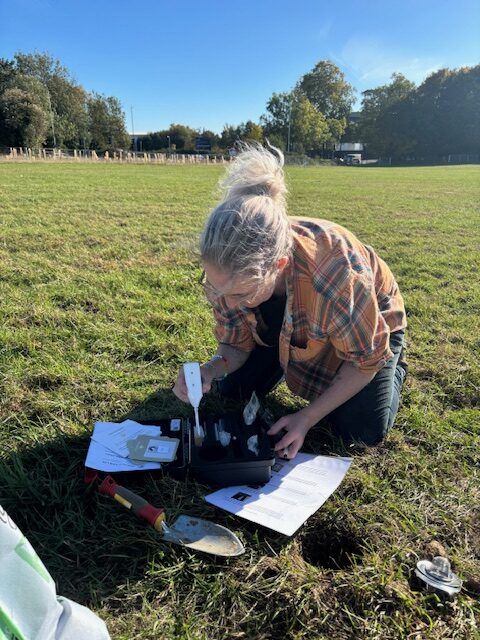
Recently, the Soil Association team was at Woodoaks Farm in Hertfordshire, England collecting soil samples as part of the AI 4 Soil Health project (AI4SH). Madeleine Silberberg, Project Coordinator, coordinates 13 pilot sites across the continent in partnership with leading European institutions. These sites, covering 11 pedoclimatic regions, were selected based on distinctive soil qualities. The team are using advanced measurement techniques, generating new insights into the health of Europe’s soils, testing the assumptions in their models, and helping determine the best monitoring tools for the future.
Soil Association Farming Advisor, Karen Fisher, shares her experience using microBIOMETER® on this project.
“microBIOMETER® turned out to be a genuinely exciting addition to the toolkit. The first test took me a little while, carefully following the instructions step by step, but once I got into the rhythm the process was surprisingly straightforward. The longest part was waiting for the sample to develop but that slotted in nicely while we collected bulk density samples and soils for lab analysis.
I did have a small hiccup with scanning the first card, but I think my app might have been on the wrong mode, but after that everything worked perfectly. Each scan felt a bit like opening a present. I found myself looking forward to seeing what the next result would show.
It was fascinating to see the different patterns emerging across woodland, permanent grassland, conservation fields and compost. Some results weren’t quite what you might expect, for example, a woodland showing a lower fungal: bacterial ratio than a long-term grass field. It is a reminder that context matters: soil biology reflects both current conditions and land use history, and sometimes regeneration takes time.
These kinds of rapid, field-based tools do not replace lab analysis, but they bring soil life into focus in a way that is both practical and accessible. Over time, repeating these tests across seasons and management practices will help us build a richer picture of soil health and feed into the development of different indicators.”
Senior Farming Advisor Josiah Judson, “‘It was great to be out in the field making sure the tools we’re developing actually make sense on the ground and can support different users. It’s an ambitious goal to map these things across so many different landscapes, but the more data we can get, the better!”
 Informal science education is a key for community engagement and healthy gardening. Community gardening brings numerous benefits such as fresh produce, therapy, physical exercise, reduction in grocery bills, improvement of mood among many others.
“Last weekend I had the privilege to teach community gardeners on the importance of soil testing side by side with my very first student at NYBG Adult Education program (class 2015). Dr. Joan Basile is a clinical psychologist who has developed her own horticulture therapy program incorporating soil knowledge brining therapy & soil science & gardening together.” – Dr. Anna Paltseva, soil_expert.
⠀
“While the microBIOMETER® results showed there is room for improvement, the result from last year’s beds also proved that composting and mulching practices are paying off in increased soil life. This means that sandy soil will gradually be able to hold nutrients better and better!” – Dr. Basile
 Sustainable Organic Q8 was launched in mid-2018, educating people on recycling their organic waste, being environmentally aware and teaching people how to grow whatever and wherever they can. As far as gardening/farming styles, Sustainable Organic focuses on the value of the living soil and the soil food web and teaching home gardeners and farmers to slowly shift the general culture from MONOCULTURE, “Babysitting plants” and providing all their needs from nutrients to medicine to DIVERSITY, Building and regenerating an ecosystem that will take care of itself or at least be a bit less exhaustive and much more sustainable.
Sustainable Organic has helped bring diversity above grounds back to the region in the past couple years. However, many people are still very new to the life underground and living soil. Their gardening/farming practices rely heavily on providing nutrients and immunity/medicine to plants. To them it is cheap, it works, and they’re so set in their ways that the idea of change is becomes a source of anxiety.
Although more and more gardeners are praising the life in the soil, they also practice routine solarization and refuse to refrain from it, reflecting their hazy understanding of soil biology and the soil food web and what it really takes to construct. Testing the soil to most growers means checking nutrient availability, water content and pH.
For the sake of adding some objectivity to soil biomass and increasing the value of soil biomass testing, Sustainable Organic sent microBIOMETER® test kits to popular gardeners in Kuwait, Saudi and Dubai to experiment with by testing their soils and compost. These gardeners have a large number of followers and they educate via social media, gardening courses, and workshops. By starting to broadcast microBIOMETER® as a means of testing the biomass in the soil and amending it based on the readings received, Sustainable Organic intends to create a trend in the region shifting the focus more on the life in the soil than the mineral content.
“microBIOMETER® is an innovation that has made it possible to quantify the life in the soil. This economic tool, I believe, not only helps us improve our soil at the gardening/farming level, but it can also help us deepen our understanding and comprehension of the soil food web and the LIFE underground. This will ultimately lead to a tremendous positive change at the psychological and behavioral level. It’s common to see people in our region praising the life in the soil (finally), but then professing solarization at the end of or the beginning of a grow season. This is an obvious clash in concepts that we hope are not deeply understood. We believe with popularizing the use of the microBIOMETER®, we can help clear the fog!
It’s beautiful to see people go out in the middle of the desert and start digging holes to “build” soil, plant trees and mulch around them; then announce seeing mushrooms and biologic diversity; start talking about soil biology, arbuscular fungi and carbon sequestration and tell farmers near them to try out the living soil method learned from Sustainable Organic. They say think globally and act locally. We intend to revive the desert in the Arabian Peninsula with Mother Earth and her fever at heart!”
About Dr. Jassem Bastaki. Originally from Kuwait, Jassem acquired his education in Head and Neck Endocrine Pathology in Pittsburgh, PA. In 2012, he left Pittsburgh to practice diagnostics and oncology in Kuwait and in doing so transitioned from fertile land to urban settings in some of the harshest climates in the world. The stress from his line of work led him back to gardening; indoors and hydroponic initially until he learned how to garden outdoors no matter the climate or conditions. Every second he spent with his plants taught him more and more about life and the reality we are unaware of. “We are guests on this earth with everything else that lives on it and in it.” The more he realized what was missing and where to find it, he wanted to help everyone find their way back to earth.
Jassem is a microBIOMETER® distributor in the Gulf Region as well as Iraq, Jordan and Egypt.