
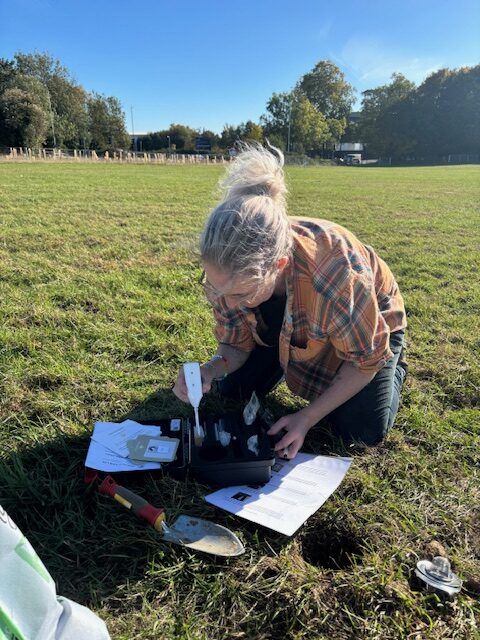
Recently, the Soil Association team was at Woodoaks Farm in Hertfordshire, England collecting soil samples as part of the AI 4 Soil Health project (AI4SH). Madeleine Silberberg, Project Coordinator, coordinates 13 pilot sites across the continent in partnership with leading European institutions. These sites, covering 11 pedoclimatic regions, were selected based on distinctive soil qualities. The team are using advanced measurement techniques, generating new insights into the health of Europe’s soils, testing the assumptions in their models, and helping determine the best monitoring tools for the future.
Soil Association Farming Advisor, Karen Fisher, shares her experience using microBIOMETER® on this project.
“microBIOMETER® turned out to be a genuinely exciting addition to the toolkit. The first test took me a little while, carefully following the instructions step by step, but once I got into the rhythm the process was surprisingly straightforward. The longest part was waiting for the sample to develop but that slotted in nicely while we collected bulk density samples and soils for lab analysis.
I did have a small hiccup with scanning the first card, but I think my app might have been on the wrong mode, but after that everything worked perfectly. Each scan felt a bit like opening a present. I found myself looking forward to seeing what the next result would show.
It was fascinating to see the different patterns emerging across woodland, permanent grassland, conservation fields and compost. Some results weren’t quite what you might expect, for example, a woodland showing a lower fungal: bacterial ratio than a long-term grass field. It is a reminder that context matters: soil biology reflects both current conditions and land use history, and sometimes regeneration takes time.
These kinds of rapid, field-based tools do not replace lab analysis, but they bring soil life into focus in a way that is both practical and accessible. Over time, repeating these tests across seasons and management practices will help us build a richer picture of soil health and feed into the development of different indicators.”
Senior Farming Advisor Josiah Judson, “‘It was great to be out in the field making sure the tools we’re developing actually make sense on the ground and can support different users. It’s an ambitious goal to map these things across so many different landscapes, but the more data we can get, the better!”
 PADK is an NGO dedicated to building capacity in regenerative agriculture techniques and soil science research. Their main initiative and focus, the Tropical Agriculture Research and Training Station (TARTS), is in the small village of Ngotto, in the East Region of Cameroon. The company’s objectives are to:
• Produce highly biodynamic and performant soil amendments.
• Restart the microbial activity of tropical soils, increasing nutrient availability, and alleviating the pressures of chemical fertilizers and pesticides.
• Increase local small-holder farmers’ knowledge of soil ecology and provide them with tangible resources to improve and regenerate their farmland.
A variety of logistical factors impeded their workflow while utilizing microscopy in their labs. Sampling was infrequent and irregular, tracking the F: B progression was difficult, and correlating with climate data and environmental parameters was near impossible.
In early 2022, Founder, Mr. Edmond Nader, came across the microBIOMETER®. Since then, they have accelerated their R&D efforts, and their results have benefited from more consistent monitoring. The benefits they have discovered while using microBIOMETER®:
• Process samples, measure the F:B ratio, and record the results using the mobile app’s Data Capture functionality, in about 20 minutes. The data capture has been a very welcome surprise as its simple to follow the evolution of substrates tested with the database and share results.
• Correlate data from other experiments and compare against our microscopy results.
• Accurately track the shift from bacterial dominance (i.e. thermal phase) to fungal dominance in their composting efforts.
“The microBIOMETER® has been an invaluable tool. It has helped our organization to better document results and follow the evolution of our efforts. We have found results to be accurate against most of our microscopy verifications and we trust the results. We are eager to share our experience with this tool with others and promote its use in sub-Saharan Africa, tropical climates, and elsewhere. There are few useful field tests available, especially useful in such rural areas as we work, the microBIOMETER® has been a very welcome addition to our laboratory and field studies.”
 Different methods measure different fungal and bacterial populations. The chart below, adapted from Wang et al review of 192 different F:B ratios, illustrates how three different methods came up with three different F:B ratios for Forest, Farmland and Grassland. Note that microBIOMETER® correlates well with the gold standard, microscopy. By plate culture, forest F:B is about 1/3 that of farmland, whereas PLFA forest F:B is slightly higher, and microscopy and microBIOMETER® forest F:B are 10 times higher than farmland.
