
 Francis Lawton an 8th grader at St. Timothy School in Los Angeles, CA utilized microBIOMETER® in his science fair project titled “The Effect of Greywater on Plant Growth, Soil Microbial Biomass Carbon, and Soil Fungi to Bacteria Ratio. Francis took first prize at the fair and moved on to the Los Angeles County Science & Engineering Fair where he placed 3rd in his category of Ecology. He also received a special award from USAID (U.S. Agency for International Development). Francis then took part in the California State Science & Engineering Fair in the category of Earth & Environment (Air/Water) and placed 2nd!
Have a science fair project coming up and would like to incorporate microBIOMETER®? Please contact us!
Project Abstract:
This project was designed to find out if greywater and treated greywater can safely hydrate plants, and promote plant growth, just as well as tap water. I live in drought-prone California and it’s important to find different ways of conserving water. My experiment tested the watering of grass pots with three different types of water (independent variable): Tap water, Greywater, and Greywater treated with Activated Charcoal. Over the course of 8 weeks, I measured plant growth, soil Microbial Biomass Carbon (MBC) levels and soil Fungi to Bacteria (F:B) ratio (dependent variables). Many controlled variables ensured a valid experiment. I hypothesized that each of the water types would result in the same growth rate, soil MBC and soil F:B ratio. My hypothesis, however, was incorrect. Greywater resulted in stunted growth and spiked the F:B soil ratio so high that the pot sprouted 13 fungi heads. Tap water and Treated Greywater, however, were equally good in terms of healthy plant growth and both pots had the two best average F:B ratios closest to 1:1 (which is the best ratio for grasses). Neither of these pots produced fungi. Soil carbon levels (MBC) fluctuated for all three plants, however each plant maintained an “Excellent” level. This indicated that each water type was fine for watering grass if you don’t mind stunted grass growth and some fungi in your lawn. My experiment also proved that Activated Charcoal effectively “adsorbs” chemicals in greywater that alter a soil’s F:B ratio.
 The microBIOMETER® was developed with the need in mind to deliver a device that could be manufactured very reasonably so that it could service the whole world. For over 50 years scientists have known that microbes are the best indicator of soil health. One of the common methods used for determining soil microbial biomass is the Chloroform Fumigation Extraction (CFE) test. However, being a costly lab-based test makes it an unattainable option for many. Another method that’s often used to assess soil microbial communities is microscopy. While microscopy is one of the best ways to assess soil microbes, microscopes can be expensive, are often too large and heavy to bring into the field, and are not necessarily easy to use or easily accessible for growers around the world. In 2014, Dr. Fitzpatrick began developing the microBIOMETER® to address these shortcomings.
The microBIOMETER® was designed to detect bacteria and fungi by their pigmentation on a specially designed membrane. An extraction powder was developed that contains different salts, which, combined with precise whisking, separates the microbes from the soil particles. The addition of this extraction powder also helps to precipitate the soil so that the microbes stay suspended as the soil precipitates to the bottom of the test tube.
Once the microbes are separated from the soil, they can be detected by spectrophotometry. However, like a microscope, a spectrophotometer is both expensive and too large to use in the field. The solution, in keeping with the goal of manufacturing a very cost-effective device, was to make it a lateral flow membrane. Almost all medical devices do a vertical flow, but a vertical flow has many technical problems. In a vertical flow, different types of membranes are put together and then a clamshell type device is used to press it down, but this pressure then has to be regulated. And Dr. Fitzpatrick, having worked with many clamshell devices, knew this method caused a great deal of seepage around the outside. A lateral flow, on the other hand, is more rapid than a vertical flow which allows the sample to be put on more rapidly than you can when you’re using a vertical flow device. The flatness of the device is important as well. Most other devices that are vertical have a rim around the area where the membrane is which is called a sample well. If you look down the well you cannot see the bottom because the well walls are casting a shadow. But microBIOMETER® is flat, therefore, a shadow does not pose a problem.
To perform the test, three drops are applied to the membrane in the test card. The microBIOMETER® membrane was carefully chosen so that it would not bind any of the common pigments you might find floating in soil. It only collects microbes on the surface of this membrane. The membrane also whisks away the liquid and traps the microbes on the surface. The color that it gives to the membrane can be compared to a grayscale, which tells you that the intensity of the color, not the color itself. The intensity of the color correlates with the quantity of microbes you have. Just like with the colorimeter or spectrophotometer, the intensity of the color is linearly related to the concentration of microbes. Dr. Fitzpatrick came up with this grayscale idea while thinking about a quilting secret. Quilters want to make sure they not only have different colors but have different intensities of color as well. Therefore, we’re not just measuring color but also measuring the intensity of the color.

 The next step in the development was to figure out how to read the test cards. In the early version of the microBIOMETER®, a red filter with a grayscale was used, turning it monochromatic. A piece of red cellophane was put over the grayscale in the sample window and the results were determined by how dark the center was. This earlier version of microBIOMETER® is still being used by customers who are non-tech users.
At this point, the test could be read visually but it lacked precision, and data storage and tracking capability. For this, it was decided a phone app was needed. One of the barriers to lab testing in developing countries is cost, but another is infrastructure. However, cell phones are ubiquitous. If an app to read the test cards and store the data was created, soil stewards all over the world would have the ability to track soil health over time and assess their management practices while making changes in real time.
The challenge to the cell phone is that cell phones have a camera and manufacturers utilize different software. Therefore, the image viewed isn’t raw and overcoming the differences between various phones becomes necessary. The microBIOMETER® does that with the monochromatic grayscale backing. This in essence “tricks” all phones to be in the same range in their software and white balance. The issue of different color temperatures was also encountered. When you’re out in the sun on a cloudy day or you’re in the shade on a sunny day that light is extremely blue. When you’re sitting in your living room and you have a 60-watt light bulb, that light is yellow/red. And if you’re at the office with a fluorescent light that light turns out to be white -where red, green, and blue are all equal. Therefore, accounting for differences not only in cell phones but in ambient lighting conditions became important as well.
This stage of test development consisted of vigorous testing and a good amount of trial and error. The process involved running around with a test card from light source to light source with five or six different phones making sure the readings were consistent. By utilizing the camera’s flash in conjunction with a monochromatic backing, the images between phones became uniform. Once the patented algorithm that compensated for differences in light color and intensity and phone software was finalized, in 2018, the microBIOMETER® was released to market.
 A few years later, in 2020, Dr. Fitzpatrick and Dr. Trexler tossed around the idea of adding another soil test to the microBIOMETER® platform; the fungal to bacterial ratio. During one of these discussions, Dr. Trexler inquired if there was a way to use size to differentiate bacteria and fungi. As a microbiologist, Dr. Fitzpatrick knew that bacteria are much smaller than fungi and therefore could be differentiated based on size. Dr. Trexler then wrote software that could detect and pick out the bacteria and fungi. It was discovered that when looking at a fungal to bacterial ratio on the microscope, a slight change in the color was evident; fungi are a very, very slightly different color than bacteria. There was a correlation between the color of the sample and the fungal to bacterial ratio that was detected microscopically, which turned out to be a groundbreaking discovery. After trying various methods for determining the fungal to bacterial ratio by color, it turned out cell phone cameras had the ability to pick up the difference. This discovery led to the fungal to bacterial ratio data being added to the microBIOMETER® app.
The following year, another exciting feature was added to the platform; Project Management (PM). A big advantage of reading results with a cell phone is that the data can be stored on the cloud. When the app was first written, there were a few different data fields for each sample. There was crop quality, crop type, soil class, and a couple other generic fields. It was soon realized that people using the test were likely more knowledgeable about what data and metrics assisted with farming. So, the app was updated to allow users to create their own fields based on their needs. This development was the release of Project Management (PM). Now, users can have as many fields of data as they want and it’s completely adjustable. Another benefit of PM is it lets users create a project and anyone on the team can upload their test results to the project. Before PM, everyone’s samples were on their own phone and in their cloud account. Now all the samples, regardless of who performed the test, are in one place and can be easily downloaded for analysis. Users can create as many projects as they want to keep trials separate from each other, but with all the data aggregated. There is one microBIOMETER® customer who currently has 20 different projects that match up with each of the properties they manage.
microBIOMETER® allows users to quickly determine if they are achieving the improvements they are looking for; track soil microbial activity over time and see how it varies with practice in order to assess what is working and what is not. With an innovative, yet inexpensive soil test like microBIOMETER®, $7 to $14 compared to much more expensive tests, growers can sample more per acre, allowing them to acquire a better understanding of their crops. With the ease of multiple sampling combined with data storage, users can view year over year and season over season results to see if their microbiology is increasing and if their soil health is increasing as a result.
 It is important that the microbiology increases because there’s an incredibly high correlation between soil biology and soil health. We know that as microbial activity increases, so does the water holding capacity of the soil. It also makes crops more resistant to excess water – which can lead to erosion. Soil microbes build soil structure, which mitigates drought as well as flooding risk because it improves the texture of the soil. Microbes make a glue-like substance which enables them to stick to the soil. This stickiness remains after the microbes die and causes the soil to become clumpy. These clumps allow the soil to hold more oxygen, as it provides more aeration. Growers can improve the amount of carbon in their soil since the stored carbon in your soil is the bodies of dead microbes. When a microBIOMETER® soil test is performed, you’re looking at a snapshot of the microbes. They’re constantly turning over and they are food for other predators in the ecosystem. But that turnover demonstrates that you have a large number of microbes and that the entire ecosystem is being fed.
When you feed the soil ecosystem – from microbes to earthworms to mammals – that’s when you achieve the healthiest soil. Many creative and innovative practices are being developed that understand that healthy soil is part of a healthy system. The start is a healthy microbial ecosystem and microBIOMETER® gives you a glimpse into that very, very quickly. There’s nothing else like it.
This article is based on the video The History and Science behind microBIOMETER®

Fig Tree Organic Farm produce at the farmer’s market
Adam Jone’s Fig Tree Organic Farm in Queensland, Australia has moved to organic farming. This farm is one of the key producers of foods for the Organic Weekend Sunshine Coast markets, a famous destination for food consumers and tourists. Adam had spent a lot of his time trying a variety of different solutions to grow his crops for market.
Then, Adam met Bronwyn Holm, founder of Earthfood. Arriving on Figtree Organic Farm, Bronwyn and Adam tested the soil with microBIOMETER®; a soil test Bronwyn has been using for some time. The results showed Adam that Australian soil is damaged. This damage is caused by years of hot bush fires, extended lack of rain, overuse of chemicals, topsoil drying out and blowing away, nutrients locked up making soil water-resistant and land surface flooding. This is Australia. It is an ancient land of beauty with extremely damaged farms.
The microBIOMETER® test results also determined the soil was very low on microbes and fungi, and other tests showed it high in acid forming chemicals, probably from the previous owner. Adam was working hard making composting baths and worm juices, yet there was no deep repair due to many years of damage. The microBIOMETER® soil test was evidence that things needed to be done differently.
Bronwyn then explained to Adam the benefits of using Earthfood products which are made by using live microbes, and how they could change his farm’s health, crop yields, and increase his farm’s income. The two filmed a documentary on the farm just after planting. The original crops in the film were up to their knees and the trees to their waist.
Then after using Earthfood for three months, another microBIOMETER® soil test was performed, and they began to see some improvement. The crops seemed settled, and the pumpkin vine which usually has one crop per season had several wheelbarrows of produce. Adam was pleased with the results so far.

Bronwyn and Adam soil testing
At month nine, they ran more soil tests and took another collection of images and were excited about the changes. The soil under the cover crops was cool, and consistently damp when outside the farm boundary the environment was hot and dry. The trees were now two meters above their heads and all bush crops were up to their waist full of produce. The same pumpkin vine produced three crops in the same season and 2.5 tons of produce. The nine-month-old banana trees that were to their waist previously and not doing well were already fruiting and grown way above their heads. It would normally take eighteen months for these trees to grow and fruit. This outcome proved to be very profitable for Adam and he was happy with the results.
Since then, Adam has dove further into the regenerative farming and microbial world. He holds talks and field days, educating the public on the importance of microbes and syntropic farming. He’s found the crowds are getting bigger and bigger each time, which he believes is a result of consumers becoming more aware of their food and the environment in which it is grown.
Earthfood is excited to share their next documentary with us as well which they are currently finishing up. This documentary is on a farm which grows Heritage tomatoes, beans, squash, kale, dragon fruit, papayas, citrus trees, avocados trees, bell peppers, Japanese greens, bananas, and herbs of all kinds.
“Unless you can measure your soil foundations and biology, it is a guessing game on what can be grown to its potential,” Bronwyn said.

ABOUT EARTHFOOD:
Earthfood is rainforest in a bottle powered by live microbes. Historically handed down in my family since the mid-1880s and used in the Internationally awarded Hermitage Estate Wineries (Dalwood Estate now as one of them) when Eggert Holm, my great-great-grandfather, was their master winemaker using live microbes. With a soil scientist the IP for suspending the microbes to sleep so that the microbial concentrated solution can now be sent globally, and the microbes survive and thrive whether used in a pot-plant or on acres of farming food.
Earthfood has been supplying their liquid microbial concentrate to farms for the past 25 years, in the U.S., Central America, and Australia as well as in trials of vineyard owners in Bordeaux, France, and sugarcane farmers in Fiji, to name a few.

You’ve probably read how important it is for your soil to have a large, diverse microbial population, but how do you know that all those microbes are good?
Well to start, a healthy and optimal microbial population in your soil will always have a mixture of good and bad microbes. Together, these microbes perform important tasks to keep the soil functioning and the plants flourishing. Despite the complex relationship between plant and soil microbes, research suggests that soil microbes play a significant role in nutrient cycling, structuring plant communities, influencing plant performance and growth, and in disease control, which is why it’s so important to have a dense and diverse microbial community.
Thankfully, these soil microbe-plant interactions are self-regulated. And to keep these microbes functioning and plants thriving as they should, there’s a system of checks and balances that occurs within soil. For example, in a healthy, diverse soil mixture, microbes help plants suppress pathogens by inducing natural plant defenses, producing antibiotics, fighting against pathogens, or through the hyperparasitism of the pathogen. However, when there is an influx of pathogens in a not-so-healthy and diverse soil, things will start to function differently.
Once there’s a large enough influx of pathogenic microbes that have colonized within the soil, these microbes will produce chemical signals called autoinducers, which regulate microbial gene expression in a process called quorum sensing. In this example, quorum sensing allows those microbes to communicate with each other and change their genes to become virulent. Soil can become more susceptible to virulent factors if there isn’t adequate microbial diversity, as a diverse microbial community is critical to maintain ecological processes. To mitigate the negative aspects of quorum sensing, it’s imperative to have a diverse vegetation aboveground and a diverse microbial community belowground.
However, despite the good microbes’ best effort, soil conditions change and sometimes pathogens can take control. Depending on the pathogen, different physical signs and symptoms will become evident on the plant. Common signs of pathogenic disease on a plant can include foliage wilting, stunting, browning, and yellowing. Fortunately, because these are all aboveground symptoms, diseases can be easier to identify and potentially treat. Though, there are common belowground pathogens that affect the root systems of plants. These are more difficult to diagnose as they don’t always produce physical signs on the plant. The only way to specifically identify the pathogenic microbial species within your soil is to send your soil’s DNA to a lab for further analysis.
The best method that researchers have found to combat these soil pathogens is by supporting the good microbes, as the best defense is a good offense. Because microbial diversity has an almost linear relationship to microbial biomass, increasing the soil’s microbial biomass will increase its microbial diversity, which is the key to having a functioning and thriving ecosystem.
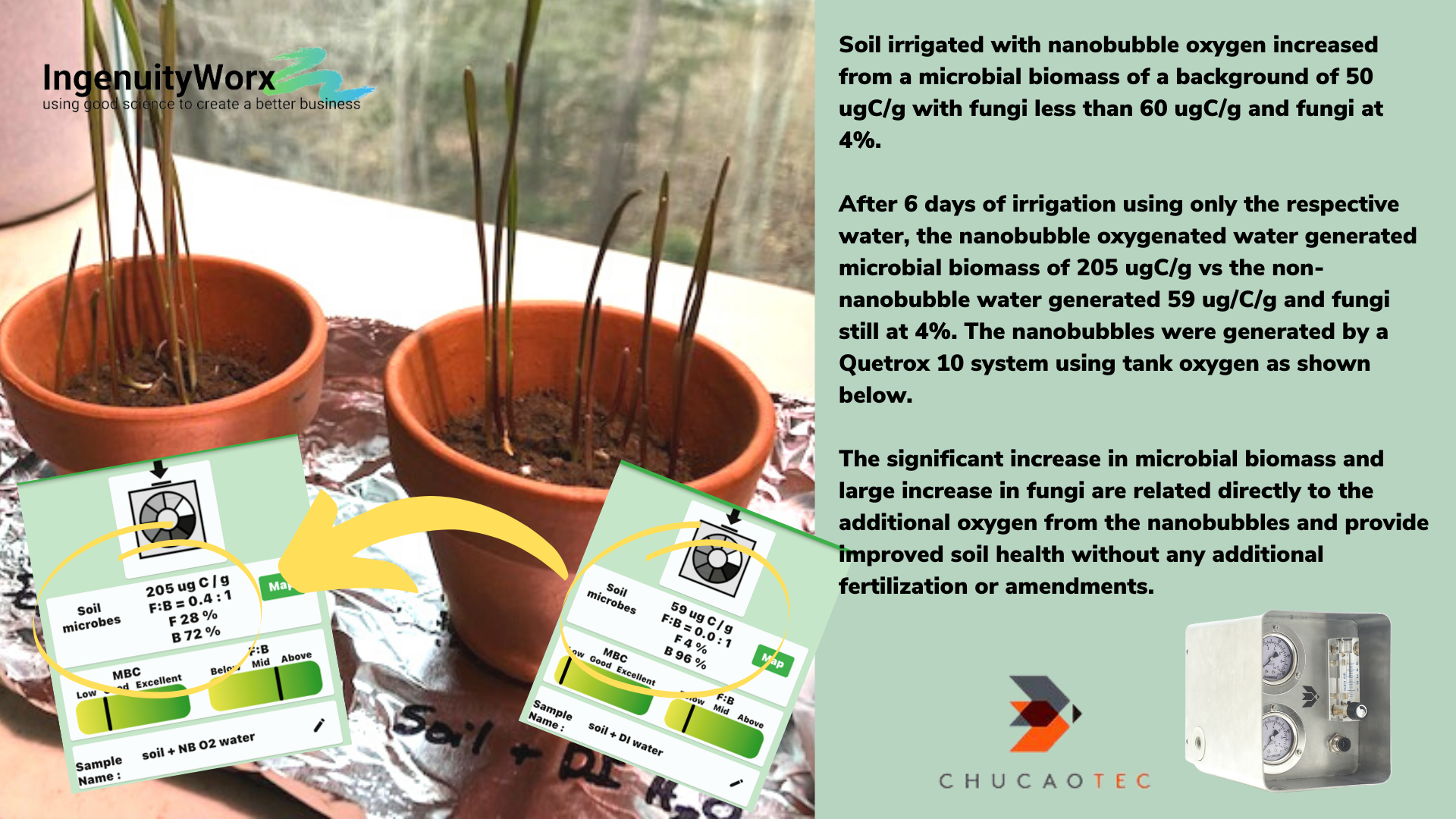
IngenuityWorx has been working to prove that the application of nanobubble oxygen as an irrigation/fertigation tool can provide low cost, easily applied plant benefits both indoors and outdoors.
It has been known for over 40 years that increased oxygen to plant roots in soil improves nutrient absorption, reduces effects of saline water or sodic soils, and increases plant growth and yields. However, traditional aeration technology prevented its use. Aerated water was limited to very short application duration and limited travel time in an irrigation line with low oxygen transfer efficiency.
The new science of nanobubbles allows us to add high dissolved oxygen concentrations, reaching 30-50 ppm, and the oxygen transfer will continue to take place for weeks. The nanobubbles don’t coalesce and break like macro bubbles, they move within the water using Brownian motion, and upon giving up all their oxygen produce small amounts of reactive oxygen species including hydrogen peroxide. This feature provides a built-in cleaning process that removes biofilm.
The microBIOMETER® analysis here shows that high dissolved oxygen in the irrigation water stimulated the microbial biomass and fungi to increase in number indicating a healthy microbiome in the soil for plant growth.
Additional work is ongoing to measure and understand the effects of the oxygenated water and microbial increases as it relates to soil carbon utilization, and its impact on carbon reserves and available nutrients. For more information, please contact bo*@***********rx.com.

Effects of Herbicides on Soil
Working with students to help them better understand the complexities of soil as well as fuel their passion for the life underground has always been one of the primary goals of our company. These young minds are vital to the future of our planet.
Recently, we had the pleasure of working with Emaan Ashfaq, a ninth grader at Ashfaq Homeschool. Emaan performed a science project titled Effects of Herbicides on the Soil. The project used microBIOMETER® to analyze the impact of glyphosate and natural weed killer on the soil’s fungal to bacterial ratio.
Emaan presented the project at the Pittsburgh Regional Science Fair and placed 3rd in the Earth and Environment category. Congratulations, Emaan!
If you would like to utilize microBIOMETER® in your science fair project please contact us!
 An interview with the San Antonio Food Bank who is using microBIOMETER® in their Farm and Garden Program.
How are you using microBIOMETER®?
We are using microBIOMETER to track the soil health on our farms, gardens and compost. This test allows us to understand if we are providing an environment for our crops to thrive. Because we grow fruit trees, herbs and annual edible crops the fungal to bacterial ratio helps us identify the current soil health and help us understand what strategies we can look to implement to improve that environment over time.
How does microBIOMETER® help people understand the importance of soil biology as opposed to the historical focus on soil chemistry?
Traditional soil tests give you a window into what nutrients are or are not available within your soil. It can give you insight into how much organic matter might be present in your soil, but not how you might work to track progress on soil health, diversity or improving your soil food web on an affordable level. While knowing the nutrient breakdown is helpful information it does not help you understand if you are providing an ideal environment for those micro and macro organisms to thrive and ultimately aid your crops or plants in receiving those nutrients and so much more. The microBIOMETER® test kit has helped us better understand our complex food web and what strategies we can do to create a more balanced environment for our crops and our soil.
How did the microBIOMETER® information assist you with your project?
This test helps us to educate not only our staff on soil health strategies, but also our volunteers and anyone who attends are Teaching Garden classes. The data we collect helps us to showcase how the strategies we are employing to improve our soil health are making a difference from season to season as opposed to every two years from a traditional soil test. That enables us to make better recommendations to our community of growers about ways they can improve their soil, too.

About the San Antonio Food Bank
The San Antonio Food Bank takes pride in fighting hunger, feeding hope in our 29-county service area. We believe that no child should go to bed hungry, adults should not have to choose between a hot meal and utilities, nor a senior sacrifice medical care for the sake of a meal.
Founded in 1980, The San Antonio Food Bank has quickly grown to serve 90,000 individuals a week in one of the largest service areas in Texas. Our focus is for clients to have food for today but to also have the resources to be self-sufficient in the future.
Fighting hunger is our number one priority but we also serve to educate and provide assistance in many other ways. We achieve this through our variety of programs and resources available to families, individuals, seniors, children, and military members in need.
Our Farm and Garden Program consists of two locations and six growing spaces, including two farms and the garden at the New Braunfels Food Bank. Together these areas total more than 100 acres and provide 300,000 pounds of fresh local produce annually to our 29-county service area. We utilize 5,000 volunteers annually to assist with our operation and to provide local produce to the community.
Our Farm and Garden Program strives to provide quality, local produce to the community and to provide resources to teach those in our community how to grow food for today and in the future. In order to meet those goals, we start with our soil. By understanding our soil biology and health we get a window into what is happening at the root level and better understand the environment where our crops live and how to make improvements so we are growing healthy plants and nutritious crops. We believe everyone deserves access to nutritious fruits and vegetables.
Our Teaching Garden classes provide information about the importance of soil and composting as a foundation for building soil diversity and health. We utilize cover cropping on the farms and in our gardens to reduce erosion, build soil fertility, reduce weed pressure and increase organic matter. We create and utilize composting to increase the diversity of our soil, divert valuable resources from the landfill and introduce the community to the benefits of composting at home or in the community.

Zack Shier, Joseph Tree Service
Effects of Humate and Organic Based Soil Treatments on Urban Soil Characteristics
Zack Shier, Board Certified Master Arborist and Plant Health Care Manager at Joseph Tree Service, is utilizing microBIOMETER® in his study titled Effects of Humate and Organic Based Soil Treatments on Urban Soil Characteristics.
Introduction to the study. Urban soils have long plagued tree care providers with a difficult obstacle to tree health optimization. The very nature of how our urban soils come to be makes it quite challenging to diagnose the major issues with our soils, let alone correct those issues consistently, and with enough efficiency to make it affordable to clients.
When buildings or homes are built in our cities and towns, the natural layout and structure of soils is heavily modified, and often changed in erratic ways. Large holes are dug, bringing soil horizons meant for the deep areas, to the surface; mixing heavily with surface horizons. The top O and A soil horizons are often scraped clean to level surfaces, moving them or completely taking them away. Outside products, like “clean-fill” are often brought in, adding foreign soil or even rock (like quarry, limestone fill) into the surface soil area.
On top of this sub-par growing medium we’ve created, we also plant turf or put asphalt and concrete into most of the area. We then rake up and get rid of all organic litter and material, continually robbing the soil of the reincorporation of organic matter that forests are accustomed to. To add to the problem, urban trees are grown quickly using synthetic fertilizers on tree farms, and then dug up to be planted, cutting anywhere between 50-90% of their roots off, and often planted in different soil than they were grown in.
This entire predicament creates poor chemical, physical, and biological soil characteristics, resulting in poor urban tree growth, increased insect and disease populations, and high rates of nutrient deficiencies. (Read more)
 This article was provided to us by Scott Hortop, a retired volunteer and now student of soil, located in the Ottawa Valley, Ontario, Canada. Scott wants to use his retirement to do one important thing for the climate.
At ONfungi we own two microBIOMETER® soil testing kits which we use to determine the fungal to bacterial ratio (F:B) of the Johnson-Su fungal dominant compost (FDC). The ONfungi group makes FDC from tree leaves.
We are excited by the potential of leaf mold to:
• Reduce agricultural dependence on external inputs
• Divert leaf organics from landfills
• Replenish the inventory of carbon in the soil by drawing down the carbon in the atmosphere
• Grow knowledge about working with mother nature to address climate change
Our first FDC bioreactor batch was started in Spring 2018. Since then, we have put up a total of 15 batches; 8 of them in fall 2021.
“It took us 3 batches before we faced the fact that we needed to know whether what we were producing was actually what we hoped it was. Our enthusiasm needed to be grounded. What is the fungal bacteria (F:B) ratio in our FDC?,” says Scott Hortop, wizard of compost for the ONfungi group. “This is why we have found the microBIOMETER® to be our most useful tool.”
“Dr. David Johnson’s talks have shown us eloquently how the F:B ratio is the most meaningful indicator for soil health”, Hortop explains. “As we share our fungal dominant compost (FDC) with other users, we owe them a solid measure of what they are getting. When we and others share our FDC experiments with each other at the Chico State University Registry of Johnson-Su Bioreactors, the majority of us have been unable to report F:B ratios. This has now changed. With the microBIOMETER® we can confirm that we have the right ratio of ingredients by taking a real measure of the F:B ratio.”
Its All Relative – Isn’t it the change and the direction of changes that we really need to know? Of course, it might be nice to think every microbe was identified and counted under a microscope, but that precision comes at a HUGE cost and most likely doesn’t alter the conclusion. The next thing we need to do to strengthen the microbial community.
Immediacy – When you are checking in on living microbes in soil, some of whom are reproducing and dying in a matter of minutes and others taking years, the best timing for a test is here and now. In a world rich with distraction and delay, its awesome to get a result from your testing efforts immediately.
True Cost Per Data Point – For the purpose of our bioreactors, give it a think: the modest variable costs per test, the modest labour to execute a test which is just minutes beyond the time required for sample collection, the VERY efficient and effective recording of results, and the $0 sample shipping cost.
 In an ONfungi citizen science trial last summer by one of our volunteers in White Lake, Ontario, 2 sunflower seeds were planted in late June into moderately degraded farmland (microBIOMETER® F:B 0.7:1; 464 µg C/g).
The control seed (left) received no soil amendments. The 2nd seed (right) was planted with 50 grams (a small handful) of Johnson-Su fungal dominant compost (microBIOMETER® F:B 1.7:1; 700 µg C/g) surrounding the seed. For 8 weeks both plants received identical, adequate watering. The 8-week photo below shows the control sunflower on the left suffering from an invasion of cucumber beetles with less than ½ the height and 1/3 the stalk width compared to the sunflower on the right with FDC at its root zone. Although beetles were observed on the FDC sunflower, some disease resistance was evident.
One of ONfungi’s targets this year is to do monthly tests on completed FDC material to chart the staying power and degradation curve of finished FDC, not yet put to use and in several storage modes. We are also using the microBIOMETER® to look at carbon sequestration in lawn soils.
About ONfungi; ONfungi is a happy conglomeration of active volunteer folks. Their goal is to explore, through citizen science, the use of Johnson-Su fungal dominant compost (FDC) in improving soil, storing carbon, and enhancing plant health and nutrition. Learn more at ONfungi.net

microBIOMETER® can tell you if you are increasing the nutrient value and disease resistance of your crop.
A Rodale study showed greatly increased levels of the vitamins and minerals in sustainably farmed soils as opposed to mineral fertilized crops. And at Rodale, the sustainable practice yields are the same as the paired fields farmed with mineral fertilizers – and in bad weather, and disease years significantly better. Rodale is only one of many studies showing the increased nutrient value of organically and sustainably grown food.
Now Dr. Montgomery of the University of Washington’s team in a similar study has shown that if you are increasing your microbial biomass you are increasing the nutrient level of your crop: “soil health is a more pertinent metric for assessing the impact of farming practices on the nutrient composition of crops”.
Biklé, A. and Montgomery, D.R., 2021. Soil health and nutrient density: beyond organic vs. conventional farming. Frontiers in Sustainable Food Systems.
Hepperly, P.R., Omondi, E. and Seidel, R., 2018. Soil regeneration increases crop nutrients, antioxidants and adaptive responses. MOJ Food Process Technol, 6(2), pp.196-203.